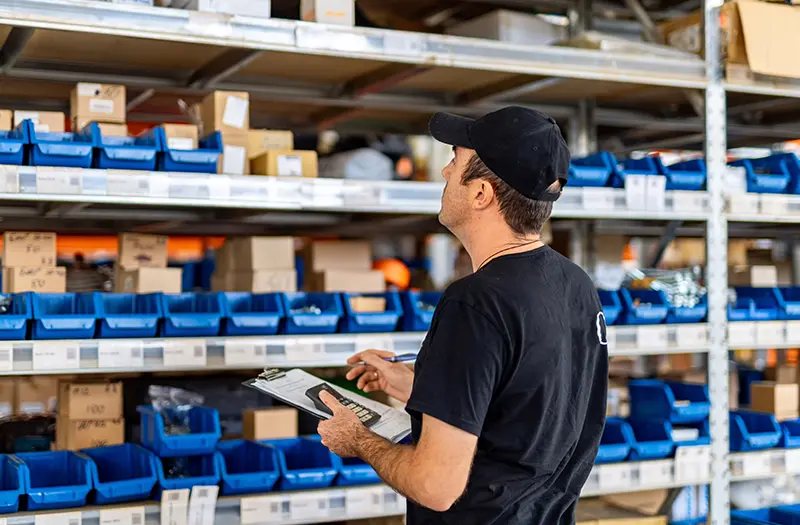

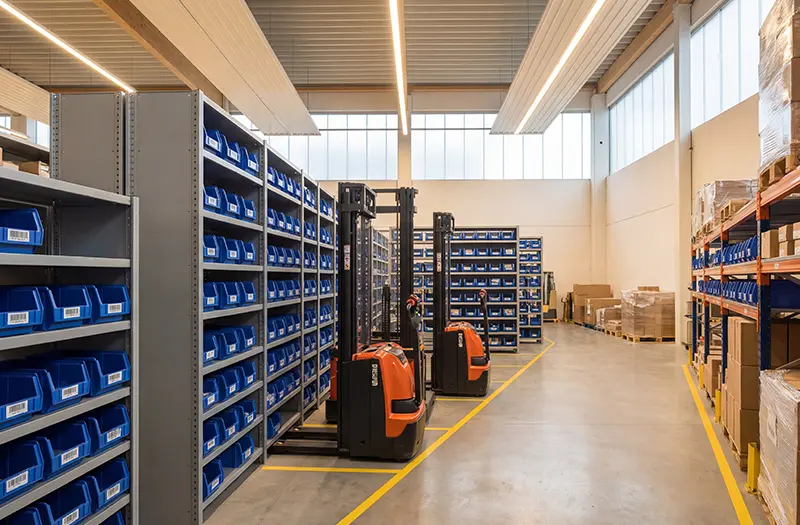
Whether you’re a wholesaler managing thousands of SKUs or a growing distribution business scaling operations, efficient stock management is essential. To help better manage warehousing, most warehouse management solutions are optimised around the use of "bins". Warehouse bins provide unique location boxes or containers which have a barcode on them so staff can quickly and easily locate products to speed up the picking process.
While storing the bulk or low-value goods may seem as basic as throwing the goods out of the warehouse, bins play an important role in increasing the effectiveness of your warehouse performance. Here's why they matter.
Better product visibility and stock accuracy
Errors and delays can be caused by misplaced items and are usually considered one of the major issues associated with delays in dispatching customer orders. When multiple SKUs share shelf space or are stored loosely in bays, warehouse teams have to rely on their own experience and knowledge as well as manual checks to confirm they are picking the right stock.[SR3]
In contrast, warehouse bins replace unorganised shelves by utilising easily identifiable containers or defined spaces. Each stock bin is assigned to one stock location. When a picker arrives at aisle 4, section B, bin 17, they know exactly where the product is located. No rummaging, no re-labelling, no time-wasting moments of “I think it’s somewhere on this shelf”.
Bin storage allows the most up-to-date information to be used in the most accurate way when counting stock, greatly minimising the risk of errors. If your inventory is isolated to easily identifiable inventory items, you can go through a cycle count much more rapidly and with significantly fewer mistakes.
You’re no longer auditing entire pallet racking levels –you’re counting a defined location with a measurable capacity. In a time-pressured environment, such insight can directly translate into fewer customer complaints, fewer returns and fewer costly delays.
Faster, more intuitive picking
Speed is crucial in a warehouse setting. Whether you're handling B2B orders for next-day delivery or stocking up retail spaces for the busy season, slow picking can drain both time and resources.
However, having bins in place makes routes much more predictable. When every item has its own designated, labelled spot, both new and experienced team members can find their way around the warehouse with ease. Instead of memorising layouts, staff can simply follow a location-based workflow.
This approach becomes even more effective when paired with a Warehouse Management System (WMS) like Profit4software, as:
- Pickers receive picklists organised by bin location rather than by product
- Routes can be optimised to follow the shortest travel path
- Multi-item orders are grouped so staff can collect items in a single pass
The result is smoother movements, reduced congestion and shorter fulfilment cycles. Even small improvements, where seconds are shaved off each pick, add up significantly over hundreds or thousands of orders per week.
Reduced mispicks and warehouse errors
When a wrong item is picked, it’s not just time that gets wasted. It also racks up costs from returns, replacements and extra shipping -plus there’s potential reputational damage from unhappy customers too.
Mistakes are more likely to occur when SKUs are mixed together in shared spaces. This is where bins become extra beneficial in removing confusion. Instead of a cluttered shelf filled with similar products, you have clearly defined micro-locations. The picker isn’t faced with a choice of ten boxes; they’re simply grabbing the one product from bin G-04-11.
Bins also make it easier to separate:
- Similar-looking items(same brand, different model)
- Components vs finished goods
- Fast-moving stock vs low-demand inventory
For wholesalers in industries like horticulture, automotive parts, tools or electrical equipment, where SKUs often look nearly identical, bin systems significantly eliminate the risk of human errors from occurring.
Improved warehouse space utilisation
A common misconception about warehouse storage is that having more space automatically means greater efficiency. In reality, it often means more unused areas and disorganised shelving, resulting in valuable floorspace being wasted.
In contrast, bins can be a game-changer for businesses, making it far easier to maximise space effectively. Instead of just piling products on wide shelves, items are neatly stored in bins that are just the right size. Bulk stock can be kept in pallet racking, while fast-moving SKUs are easily accessible in bins at a convenient picking height.
This modular strategy not only cuts down on clutter but also boosts your usable storage capacity. Plus, it makes it easier to categorise items clearly, such as:
- High-demand SKUs stored near dispatch zones
- Seasonal inventory located near inbound bays
- Fragile items stored in smaller, reinforced bins
This structured layout not only improves stock visibility it also transforms the warehouse into a more ergonomic working environment.