
ERP Software & ISO 9001
ERP solutions can help you to achieve the ISO 9001 accreditations as it's designed to do the very things that ISO is checking and enforcing. Find out more.

With 50 years' experience in the wholesale and distributor sector, we have put together a 14-page guide on the key facts about ERP. Download yours for free.






The UK electrical wholesale market is valued at roughly £4.28 billion, with annual growth tracking at a moderate average of 3% to 4% according to Barbour ABI. However, topline numbers hide a much harsher trading reality. The Electrical Distributors' Association (EDA) State of the Sector Survey reveals an industry navigating a complex mix of rising sales volumes pulled down by highly volatile supply chains and severe margin pressure.
While industry demand remains generally optimistic, geopolitical disruptions—specifically the Middle East crisis—have introduced heavy friction into the UK electrical supply chain. When supplier costs shift on a weekly basis and contractors shop around aggressively online, independent wholesalers can no longer run their trade counters on legacy systems or fragmented spreadsheets.
The state of the industry highlights an interesting paradox. Growth is there, but operational costs are threatening to wipe out the benefits. Wholesalers are caught in a commercial pincer movement that demands tighter internal efficiency.
Macro outlook & sales volumes
On paper, demand looks strong: 72% of wholesalers predict their overall sales volumes will increase across the year, and 34.66% reported Q1 turnover jumps of 11% or more compared to the previous year. However, respondents heavily note that "margins are under heavy pressure from online sellers".
Top operational challenges
When surveyed on their most pressing business bottlenecks, electrical suppliers consistently point to increasing business overheads (such as National Living Wage increases, rent, and energy), downturns in traditional market demand, and severe staffing shortages. Additionally, 42% of wholesalers explicitly cite manual data input as one of their biggest operational headaches.
Supply chain & geopolitical disruption
The Middle East crisis has disrupted shipping lanes and triggered cascading logistics issues within the UK:
Because of this, 69.49% of wholesalers are stuck in a loop of manually adjusting their pricing files more frequently to ensure they do not sell stock at a loss.
Electrical wholesaling sits at a distinct intersection. It shares basic stock management rules with general distribution, but features sector-specific operational variables that generic packages routinely fail to handle.
High SKU counts & technical attributes: A typical branch carries tens of thousands of product lines. Unlike standard retail stock, electrical items carry technical specifications that matter directly to safety and compliance—including voltages, IP ratings, wattages, colour temperatures, lumen outputs, and specific BS 7671 certifications. Systems must be able to categorize and search via these parameters instantly.
Trade counter speed: Electricians and electrical contractors are highly time-critical customers. They expect instant stock data and immediate custom pricing terms while standing at the counter or calling from a job site. A system that lags or freezes directly drives trade accounts to competitors.
Complex supplier rebates & SPAs: Margin recovery depends heavily on buying well. Wholesalers navigate multi-layered frameworks of Special Price Agreements (SPAs) and volume rebates with manufacturing groups. Tracking this via manual spreadsheets is a major administrative drain and results in unclaimed rebate margins.
Evolving product categories: Rapid growth in EV charging equipment, LED installations, building automation, and low-carbon tech requires dynamic data structures to manage environmental documentation and shifting supplier options.
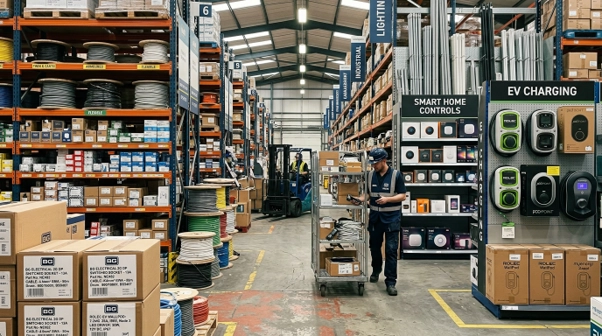 Evolving product lines add to SKU complexity.
With large product ranges and variable demand patterns, real-time stock control is the foundation of an efficient electrical wholesale operation. Look for:
The trade counter is often the primary point of contact between an electrical wholesaler and their customers. Your ERP system should make trade counter staff faster and more confident, not slower. Key requirements include:
The pricing engine in an ERP for electrical wholesale needs to handle considerably more than a standard price list. Your system should be able to manage:
Margin management in electrical wholesale depends heavily on buying well. A capable ERP gives you the tools to do that:
For electrical wholesalers running a meaningful warehouse alongside a trade counter, the warehouse module needs to support efficient operations:
 Profit4 provides everything your business needs in one system
To identify if a software provider genuinely understands the unique workflows of an independent distributor—or is simply trying to adapt a generic accounting framework to fit your industry—ask these five diagnostic questions during your software demonstration:
What to look for: In UK electrical supply chains, a massive portion of gross margin recovery relies on claiming manufacturer rebates and managing complex SPAs. A specialist ERP must automate the tracking of buying group agreements (like ANEW, Awebb, or FEGIME) against actual sales invoices. If a vendor offers vague tracking promises or relies on manual ledger updates, it is a major warning sign. Look for real-time validation that automatically flags when a rebate is due, ensuring you never leave unclaimed profit margins on the table.
What to look for: Electrical contractors are busy and often place complex, mixed orders at the trade counter. A sparky might stand at your desk wanting to pick up everyday stock on their credit account, pay cash for personal tools, and request a quick quotation for a future project—all in one visit. Your trade counter software must process account charges, cash transactions, and quotes simultaneously within a single screen view. If counter staff have to open and close multiple applications to complete one transaction, it will create long queues and hurt customer service.
What to look for: Managing an extensive product catalogue with thousands of heavy-attribute items is an administrative nightmare. A true sector-specific ERP must pull directly from the LUCKINSlive database, giving your branch instant access to over one million verified product lines, specifications, and manufacturer price modifications. If a vendor says, "We can build a custom API integration for a fee," it proves they lack a deep background in the UK electrical distribution sector. Demand a native, out-of-the-box link that eliminates manual product entry entirely.
What to look for: Real-world trade account transactions involve highly mixed pricing structures. Your electrical wholesale inventory management system must run a dynamic matrix pricing engine behind the scenes. This engine needs to seamlessly resolve a single basket where five line items are billed at the customer's standard contract discount rate, three items are linked to a specific commercial project code, and two are billed at promotional spot-rates. The software must automatically compute these variations in milliseconds without forcing staff to manually override prices, protecting your bottom line from sales leakage.
What to look for: Never accept a generic distribution case study. Managing wire and cable lengths, LED batch tracking, and multi-unit conversions requires highly specialized software logic. Ask the vendor to see active reference sites or case studies from independent regional wholesalers or members of recognized UK trade associations (like the EDA or LIA). Speaking with an industry peer who relies on the software daily is the best way to verify if the ERP can truly survive the morning rush at a busy trade counter.
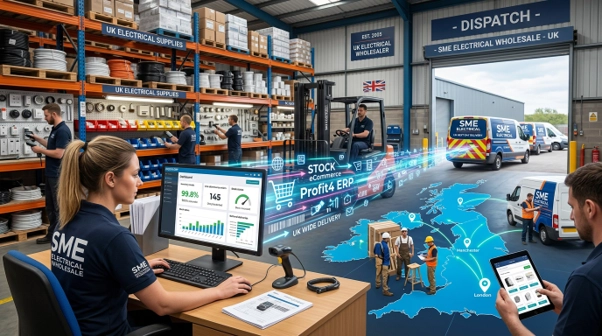 Complete, real time visibility in a single system
While massive national networks like Edmundson Electrical, Rexel, and CEF maintain roughly 70% of the UK wholesale market landscape, independent regional operators continue to protect strong positions through service flexibility and reliable local trade relationships. However, sustaining that competitive edge requires robust operational infrastructure.
Profit4 by OGL Software was built from the ground up to solve the exact operational stresses highlighted across the latest EDA sector reports. It serves as an ultimate operational equalizer, giving SME distributors the automation power of a national giant without requiring complex IT headcounts:
See how Profit4's native LUCKINSlive integration and counter speed can transform your business.

ERP Software consultant at OGL Software ERP Software for Stockists, Distributors and Merchants | Designed, Developed and Supported in the UK
