With 50 years' experience in the wholesale and distributor sector, we have put together a 14-page guide on the key facts about ERP. Download yours for free.
Your ERP buyer’s guide should open automatically. If it doesn’t, click here.
Oops! Something went wrong while submitting the form.
50 years' experience
Your data stays private
Trusted by 2,000+ businesses
How does accounts receivable software help businesses?
Discover how accounts receivable software can streamline your accounting processes. We discuss its key features and how it benefits businesses.
Accounts receivable software automates invoicing, payment tracking, and cash allocation. It helps businesses get paid faster and reduces manual data entry errors.
For growing companies, especially small and medium-sized distributors and wholesalers, integrating accounts receivable into a wider cloud ERP system ensures real-time visibility over cash flow, stock levels, and customer credit limits as part of the credit control process.
Accounts receivable (AR) refers to the outstanding payments owed to your company by customers for goods or services supplied on credit. While extending credit is key for B2B trade, tracking unpaid invoices by hand takes time and can cause costly errors.
In this guide, we explain how modern accounts receivable software works. We also cover why it matters for your bottom line. Finally, we show how SMEs can use it to scale.
Why does accounts receivable management matter?
Efficient accounts receivable management is critical to the financial health and daily cash flow of any trading business. To stay on top of revenue, accounts teams must track, match, and reconcile customer invoices with incoming bank payments.
A robust accounts receivable system ensures:
Healthy working capital: Consistent follow-ups and clear visibility over aged debt prevent cash flow bottlenecks.
Accurate financial reporting: Automated reconciliation ensures recorded ledger figures match actual bank statements.
Audit and tax readiness: Up-to-date, error-free records make VAT returns and year-end audits straightforward, minimising the risk of compliance penalties.
Key benefits of accounts receivable software
Switching from spreadsheets or disconnected accounting tools to dedicated accounts receivable software transforms how your finance team operates.
1. Eliminates manual errors
Manual data entry across multiple spreadsheets inevitably leads to duplicate invoices, misallocated payments, and reporting discrepancies. Automated workflows validate figures at every stage, protecting your business from billing disputes and compliance issues.
2. Saves finance teams hours every week
Chasing overdue invoices and manually ticking off bank statements consumes valuable time. Accounts receivable software automates routine tasks like sending payment reminders, generating statements, and matching incoming funds, freeing your team to focus on strategic financial planning.
3. Speeds up cash allocation with live bank feeds
Reconciling customer payments is significantly faster when your ledger connects directly to your business bank account. By using automated bank feeds, transaction data flows securely into your system. It lets you match incoming payments to open invoices in seconds. It does this without exposing broader banking access.
4. Strengthens credit control
Accounts receivable and credit management go hand in hand. Modern systems connect sales and finance.
How accounts receivable software helps SME distributors and wholesalers
For small and medium-sized distributors, wholesalers, and merchants, accounts receivable is rarely a standalone finance task. It is directly tied to stock movement,order fulfilment, and tight profit margins.
Standalone small-business accounting software often struggles to handle complex B2B pricing matrices, partial deliveries, and high transaction volumes. When SME distributors upgrade to an integrated system, they gain critical operational advantages:
Automated credit holds at order entry: Prevent warehouse teams from picking and dispatching stock to customers who have exceeded their credit limit or have severely overdue invoices.
Accurate invoice-to-dispatch matching: Automatically generate accurate invoices the moment goods are dispatched, eliminating delays caused by lost delivery notes or pricing mismatches.
Unified stock and financial visibility: Linking your ledger with integrated accounting and inventory management software ensures that stock valuations, cost of goods sold (COGS), and customer balances update simultaneously in real time.
Tailored B2B statements and reminders: Schedule automated, branded statements and polite overdue reminders based on custom payment terms (such as 30 days end-of-month), improving collection rates without straining long-term trade relationships.
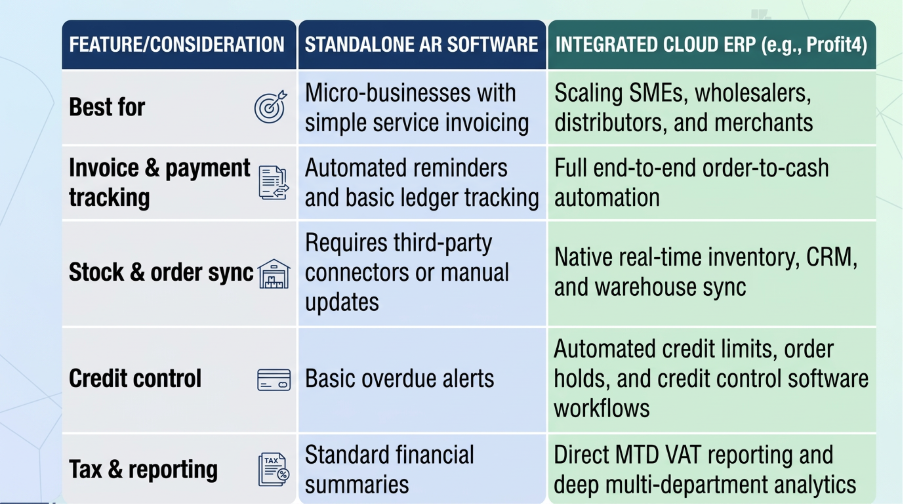
Standalone AR tools vs. integrated ERP software: which is right for you?
If your accounts team is struggling to keep up with payment reconciliations or you are experiencing rising late payments, it is time to automate your AR process. However, the right solution depends on your growth trajectory:
While basic accounts receivable add-ons work for simple setups, they often create data silos as order volumes grow. Choosing an all-in-one cloud ERP gives your business the infrastructure to scale without needing to migrate systems again in two years.
Streamline your accounts receivable with Profit4
Managing your accounts receivable doesn’t have to feel like a constant battle against spreadsheets and overdue invoices.
Profit4 is a fully integrated, cloud-based ERP system for UK stockists, wholesalers, distributors, and merchants. It supports industries like agriculture supplies, building supplies, plumbing supplies, catering equipment and more. Alongside powerful accounts receivable software, Profit4 unifies your inventory management, CRM, order processing, and automated credit control into one easy-to-use platform.
Want to get paid faster and take complete control of your cash flow? Discover how Profit4’s integrated finance and ERP tools can transform your daily operations.
Speak with the OGL team
Book a personalised walkthrough to explore how Profit4 could support your business and simplify your day-to-day operations.
Frequently asked questions about accounts receivable software
What is automated accounts receivable software?
Automated accounts receivable software is a digital tool that streamlines how businesses bill customers, track unpaid invoices, and collect incoming payments. Instead of relying on manual spreadsheets, it automates invoice generation, payment reminders, bank reconciliation, and aged debt reporting to improve daily cash flow.
How does integrated AR differ from standalone accounting tools?
Integrated AR connects your customer ledger directly with your wider business operations, such as inventory control, order processing, and CRM. While standalone tools only track basic invoices and payments, integrated accounts receivable within an ERP system automatically updates stock levels, enforces customer credit limits at order entry, and generates invoices upon dispatch.
How does accounts receivable automation reduce debtor days?
Accounts receivable automation reduces debtor days (Days Sales Outstanding) by eliminating delays in billing and follow-ups. Invoices are sent immediately when goods ship, automated payment reminders notify customers before and after due dates, and live bank feeds match incoming funds instantly, so credit teams always have an accurate view of overdue balances.
Why do SME wholesalers and distributors need integrated accounts receivable?
SME wholesalers and distributors deal with high order volumes, complex trade pricing, and tight stock margins that basic accounting apps struggle to manage. Integrated accounts receivable prevents stock from being dispatched to overdue accounts, matches invoices accurately against partial deliveries, and keeps working capital healthy without manual data entry.
Is cloud-based accounts receivable software secure for bank reconciliation?
Yes, modern cloud-based accounts receivable software uses encrypted connections and regulated open banking providers, such as Envestnet | Yodlee, to import live bank feeds. The software only reads transactional data needed to match customer payments to open invoices, ensuring your wider business banking credentials and permissions remain completely protected.
Accounts receivable software automates invoicing, payment tracking, and cash allocation. It helps businesses get paid faster and reduces manual data entry errors.
For growing companies, especially small and medium-sized distributors and wholesalers, integrating accounts receivable into a wider cloud ERP system ensures real-time visibility over cash flow, stock levels, and customer credit limits as part of the credit control process.
Accounts receivable (AR) refers to the outstanding payments owed to your company by customers for goods or services supplied on credit. While extending credit is key for B2B trade, tracking unpaid invoices by hand takes time and can cause costly errors.
In this guide, we explain how modern accounts receivable software works. We also cover why it matters for your bottom line. Finally, we show how SMEs can use it to scale.
Why does accounts receivable management matter?
Efficient accounts receivable management is critical to the financial health and daily cash flow of any trading business. To stay on top of revenue, accounts teams must track, match, and reconcile customer invoices with incoming bank payments.
A robust accounts receivable system ensures:
Healthy working capital: Consistent follow-ups and clear visibility over aged debt prevent cash flow bottlenecks.
Accurate financial reporting: Automated reconciliation ensures recorded ledger figures match actual bank statements.
Audit and tax readiness: Up-to-date, error-free records make VAT returns and year-end audits straightforward, minimising the risk of compliance penalties.
Key benefits of accounts receivable software
Switching from spreadsheets or disconnected accounting tools to dedicated accounts receivable software transforms how your finance team operates.
1. Eliminates manual errors
Manual data entry across multiple spreadsheets inevitably leads to duplicate invoices, misallocated payments, and reporting discrepancies. Automated workflows validate figures at every stage, protecting your business from billing disputes and compliance issues.
2. Saves finance teams hours every week
Chasing overdue invoices and manually ticking off bank statements consumes valuable time. Accounts receivable software automates routine tasks like sending payment reminders, generating statements, and matching incoming funds, freeing your team to focus on strategic financial planning.
3. Speeds up cash allocation with live bank feeds
Reconciling customer payments is significantly faster when your ledger connects directly to your business bank account. By using automated bank feeds, transaction data flows securely into your system. It lets you match incoming payments to open invoices in seconds. It does this without exposing broader banking access.
4. Strengthens credit control
Accounts receivable and credit management go hand in hand. Modern systems connect sales and finance.
They give you tools to manage customer credit limits. They automate chasing sequences and reduce debtor days. (Learn more about managing customer risk in our guide to credit control.)
See Profit4 in action
Join hundreds of UK distributors who have streamlined operations. No sales pitch — just a quick walkthrough.
How accounts receivable software helps SME distributors and wholesalers
For small and medium-sized distributors, wholesalers, and merchants, accounts receivable is rarely a standalone finance task. It is directly tied to stock movement, order fulfilment, and tight profit margins.
Standalone small-business accounting software often struggles to handle complex B2B pricing matrices, partial deliveries, and high transaction volumes. When SME distributors upgrade to an integrated system, they gain critical operational advantages:
Automated credit holds at order entry: Prevent warehouse teams from picking and dispatching stock to customers who have exceeded their credit limit or have severely overdue invoices.
Accurate invoice-to-dispatch matching: Automatically generate accurate invoices the moment goods are dispatched, eliminating delays caused by lost delivery notes or pricing mismatches.
Unified stock and financial visibility: Linking your ledger with integrated accounting and inventory management software ensures that stock valuations, cost of goods sold (COGS), and customer balances update simultaneously in real time.
Tailored B2B statements and reminders: Schedule automated, branded statements and polite overdue reminders based on custom payment terms (such as 30 days end-of-month), improving collection rates without straining long-term trade relationships.
Standalone AR tools vs. integrated ERP software: which is right for you?
If your accounts team is struggling to keep up with payment reconciliations or you are experiencing rising late payments, it is time to automate your AR process. However, the right solution depends on your growth trajectory:
While basic accounts receivable add-ons work for simple setups, they often create data silos as order volumes grow. Choosing an all-in-one cloud ERP gives your business the infrastructure to scale without needing to migrate systems again in two years.
Streamline your accounts receivable with Profit4
Managing your accounts receivable doesn’t have to feel like a constant battle against spreadsheets and overdue invoices.
Profit4 is a fully integrated, cloud-based ERP system for UK stockists, wholesalers, distributors, and merchants. It supports industries like agriculture supplies, building supplies, plumbing supplies, catering equipment and more. Alongside powerful accounts receivable software, Profit4 unifies your inventory management, CRM, order processing, and automated credit control into one easy-to-use platform.
Want to get paid faster and take complete control of your cash flow? Discover how Profit4’s integrated finance and ERP tools can transform your daily operations.
Speak with the OGL team
Book a personalised walkthrough to explore how Profit4 could support your business and simplify your day-to-day operations.
Frequently asked questions about accounts receivable software
What is automated accounts receivable software?
Automated accounts receivable software is a digital tool that streamlines how businesses bill customers, track unpaid invoices, and collect incoming payments. Instead of relying on manual spreadsheets, it automates invoice generation, payment reminders, bank reconciliation, and aged debt reporting to improve daily cash flow.
How does integrated AR differ from standalone accounting tools?
Integrated AR connects your customer ledger directly with your wider business operations, such as inventory control, order processing, and CRM. While standalone tools only track basic invoices and payments, integrated accounts receivable within an ERP system automatically updates stock levels, enforces customer credit limits at order entry, and generates invoices upon dispatch.
How does accounts receivable automation reduce debtor days?
Accounts receivable automation reduces debtor days (Days Sales Outstanding) by eliminating delays in billing and follow-ups. Invoices are sent immediately when goods ship, automated payment reminders notify customers before and after due dates, and live bank feeds match incoming funds instantly, so credit teams always have an accurate view of overdue balances.
Why do SME wholesalers and distributors need integrated accounts receivable?
SME wholesalers and distributors deal with high order volumes, complex trade pricing, and tight stock margins that basic accounting apps struggle to manage. Integrated accounts receivable prevents stock from being dispatched to overdue accounts, matches invoices accurately against partial deliveries, and keeps working capital healthy without manual data entry.
Is cloud-based accounts receivable software secure for bank reconciliation?
Yes, modern cloud-based accounts receivable software uses encrypted connections and regulated open banking providers, such as Envestnet | Yodlee, to import live bank feeds. The software only reads transactional data needed to match customer payments to open invoices, ensuring your wider business banking credentials and permissions remain completely protected.