
The Ultimate Guide to Delivery Route Optimisation
An optimised delivery route is the lifeblood of any successful stockist and wholesale business. Discover how ERP software with MaxOptra integration can simplify the process.

With 50 years' experience in the wholesale and distributor sector, we have put together a 14-page guide on the key facts about ERP. Download yours for free.



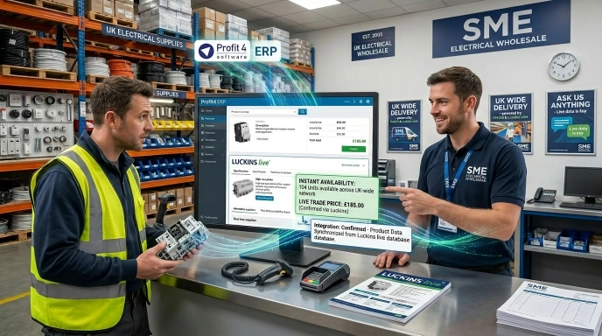


Managing an electrical wholesale business means managing an absolute avalanche of data. Between cables, switchgear, lighting, and smart-home gear, an average wholesale catalogue can easily scale to hundreds of thousands of active SKUs.
Worse, according to the Electrical Distributors' Association (EDA), the central EDATA product pool alone holds over 193,000 active manufacturer items, each requiring up to 50 distinct technical attributes like voltage, IP ratings, and compliance data to be fully accurate.
If your software is disconnected, making a single description or price update across your trade counter, mobile sales app, and webstore requires up to eight separate manual edits. One missed field, and a trade contractor orders the wrong part, or worse, you sell copper components under cost because your pricing files are lagging behind live market shifts.
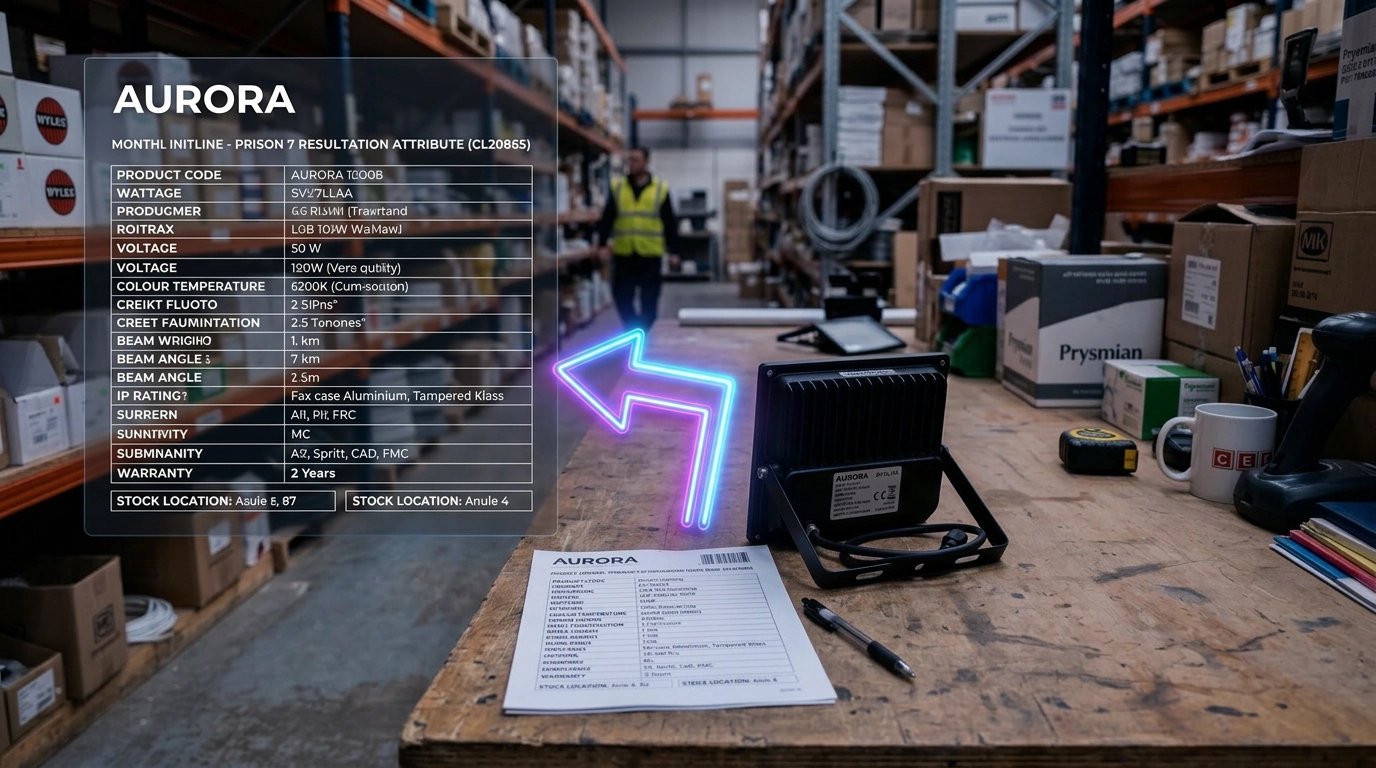 Complex, multi attribute product data is common in electrical wholesale
Ask any electrical wholesaler what makes their business operationally complex, and product data usually features early in the answer. A mid-sized electrical wholesaler might carry 15,000 to 30,000 active SKUs. A larger operation could exceed 50,000. Each product isn't just a name and a price — it's a technical specification: voltage, wattage, IP rating, cable cross-section, colour temperature, compliance certification, manufacturer code, and more.
Scaling your business shouldn't mean drowning in spreadsheets. Modern cloud ERP software like Profit4 lets you centralise, automate, and dominate a massive product catalogue without losing your mind or your margins.
ABM Electricalimplemented Profit4 a few years ago and hasn’t looked back since. Mark Ashworth, Commercial Director says:
"Since going live on Profit4, we have been able to get our stock control in order & reduced our stock holding down at any one time by about £100,000 a month. This freed a lot of cash that enabled us to reinvest elsewhere into the business & grow."
— Mark Ashworth, Commercial Director, ABM Electrical
Managing complex SKUs at scale accurately, efficiently, and in a way that makes the right information available to the right person at the right moment, is one of the defining operational challenges of electrical wholesale. This article explains how purpose-built ERP software addresses it.
In many wholesale sectors, a product record consists of a description, a supplier code, a unit of measure, and a price. In electrical wholesale, that's just the starting point.
Technical specifications matter commercially
A contractor asking for a distribution board might need to know the number of ways, the main switch rating (Amps), the IP rating, and whether it comes pre-fitted with surge protection (SPD) before they can confirm it meets the site's specification.
A trade counter operative who can answer that question instantly — without making the customer wait while they search a datasheet — is providing a genuinely valuable service.
Product variants create complexity
Many electrical products are available in multiple variants — different lengths, ratings, finishes, or certifications — that need to be managed as distinct SKUs without duplication or confusion.
Manufacturer data changes regularly
Prices change. Products get superseded. New variants are launched. Compliance standards are updated. An electrical wholesaler managing thousands of lines manually is always behind.
 Searchable attributes are critical for an efficent electrical trade counter
The ongoing conflict between the US and Iran has profoundly disrupted international shipping lanes and manufacturing costs, leaving UK wholesalers to manage an unprecedented wave of product catalogue volatility.
As vital trade routes face persistent bottlenecks and raw material supply chains fragment, manufacturers are continually forcing emergency price adjustments, changing packaging quantities, and shifting to alternative product components to keep factory lines moving. For a UK wholesaler, this means your catalogue is no longer static.
Lighting adds another layer of product complexity
The shift to LED and the growth of smart lighting has brought a wave of new product categories, each with their own specification requirements — lumen output, colour temperature (CCT), colour rendering index (CRI), beam angle, driver type, IP rating, and emergency pack options. Managing a lighting range well requires a system that can hold and surface that data without it becoming a maintenance burden.
Most general-purpose ERP systems offer a product record that handles name, code, unit of measure, pricing, and supplier reference. Some allow custom fields to be added. For electrical wholesale, this approach creates problems.
Custom fields are a workaround, not a solution
Adding 15 custom fields to a product record to accommodate technical specifications creates a database that's hard to search, difficult to maintain, and inconsistent across different product categories. It relies on individuals entering data correctly and consistently, which rarely happens at scale.
Search becomes unreliable
If a customer asks for a 12-way Type B distribution board with an integrated 125A main switch and surge protection (SPD), a system built on custom fields won't surface that reliably through search. Trade counter staff end up relying on experience and memory, which is not scalable.
Online catalogues suffer
If your eCommerce platform is pulling product data from a system with inconsistent or incomplete records, your online catalogue will reflect that — with missing specs, inconsistent descriptions, and gaps that undermine customer confidence in your B2B portal.
| Challenge | Generic / Global ERPs | Profit4’s dedicated modules & integrations |
|---|---|---|
| Massive SKU counts & complex technical attributes (Volts, Amps, IP ratings, dimensions, lumens) | Generic systems rely on messy custom fields. This makes searching highly unreliable and data entry inconsistent at scale. | Structured Attribute Database: Holds complex electrical specifications natively by category, allowing instant filtering at the trade counter. |
| Constant manufacturer price updates & product data shifts (e.g., global logistics shifts or copper price volatility) | Requires hours of manual spreadsheet imports. Outdated trade books lead to margin leakage on fast-moving trade items. | Native LUCKINSlive Integration: Automatically syncs over 1 million electro-technical items. It updates pricing and details without manual entry. |
| Trade counter queues & delayed quotes (Contractors holding their own clients on the phone or waiting at the branch) | Disconnected systems require switching between screens. Forcing a staff member to say "we will call you back" risks losing a competitive sale. | Integrated CRM & Trade Counter Mod: Unifies CRM features, live stock levels, and specialized contract pricing on one screen for fast order logging. |
| Varying Units of Measure (UoM) (Buying cables in bulk drums or pallets but selling by the individual cut metre or pack) | Multi-unit tracking breaks down or requires tedious manual calculations, creating major discrepancies in warehouse stock levels. | Multi-Unit Stock Handling: Tracks complex unit conversions automatically. It accurately calculates costs whether items are bought bulk or broken down. |
| Rapid product supersessions (Manufacturers updating LED models, smart controls, or compliance parts frequently) | Old part numbers linger. Staff accidentally sell discontinued items, creating order backlogs and shipping delays. | Automated Supersession Tracking: Flags old lines instantly. It routes the warehouse to deplete older items first before rolling to the new model. |
An ERP system designed specifically for electrical wholesale handles product data differently from the ground up.
Structured product attributes by category
Rather than relying on generic custom fields, a sector-specific ERP provides structured attribute sets matched to product categories — so cables have conductor size, insulation type, and voltage rating fields; lighting fittings have lumen output, CCT, and IP rating fields; and distribution equipment has its own relevant attributes. The structure is predefined and consistent, making search reliable and data entry manageable.
Product search that reflects how electricians think
A good trade counter system lets staff search not just by product code but by specification — finding a product by its technical attributes rather than needing to know its exact catalogue reference. That's the difference between a system that serves a trade counter and one that slows it down.
Multi-unit stock management
Fittings might be priced individually but picked in cartons. A wholesale ERP needs to handle multiple units of measure within a single product record — selling in one unit, purchasing in another, holding stock in a third — without requiring manual conversion at every step. Read more about how Profit4 handles UoM here.
Product supersession tracking
When a product line is discontinued and replaced, the ERP should manage that transition — flagging the superseded product, routing orders to the replacement, and maintaining visibility of the change for sales and warehouse staff.
The most significant practical solution to electrical wholesale product data management is direct integration with LUCKINSlive — the industry's comprehensive product database maintained by Luckins and covering more than one million items from over 800 manufacturers across electrical, HVAC, and plumbing sectors.
For electrical and lighting wholesalers, LUCKINSlive integration with your ERP transforms product data management:
Not every ERP system offers native LUCKINSlive integration. For electrical and lighting wholesalers, it should be a standard requirement in any vendor evaluation.
Managing lighting product data specifically
The lighting category deserves specific attention because of the pace at which it has changed and continues to change. The widespread shift from fluorescent and halogen to LED has not simply replaced one set of products with another. It has introduced a much wider range of variables — efficacy ratings, colour consistency standards (MacAdam steps), driver compatibility, dimming protocols (DALI, 0-10V, TRIAC), emergency pack options, and photometric data — that weren't part of the product data challenge a decade ago.
For lighting wholesalers and electrical wholesalers with a significant lighting range, the implications are:
Catalogue management and your eCommerce channel
Everything described above has a direct impact on your ability to sell online effectively. An online catalogue for an electrical wholesaler is only as good as the underlying product data. Customers browsing or searching online expect the same quality of product information they'd get from a knowledgeable trade counter — accurate specifications, clear descriptions, and confidence that what they're ordering is the right product for their application.
 Accurate specifications and clear descriptions boost online sales
In a 2026 Digitalisation survey by the EDA:
Multi-channel integration of data is no longer optional, but an essential consideration for future growth.
Product data management might sound like an internal operational concern — and in one sense it is. But its commercial impact is significant. A trade counter team that can answer technical questions quickly and confidently retains customers. An online catalogue with complete, accurate data converts better. A purchasing team that imports supplier prices automatically reacts faster to market changes and protects margin. A business that manages product supersession cleanly avoids selling discontinued lines and the customer service problems that follow.
In a market as competitive as electrical wholesale, where large nationals compete on range and price, independent wholesalers win on speed, knowledge, and service. The right ERP gives your team the data infrastructure to deliver all three.
How Profit4 supports electrical wholesale product management
You cannot manage a modern electrical wholesale business using generic inventory tools. Profit4 was purpose-built to tame the complexity of the electrical and lighting supply chains. It bridges the gap between chaotic supplier data and a smooth, profitable trade counter operation by unifying four critical pillars into a single cloud platform:
For lighting distributors, speed is the ultimate commercial differentiator. Having instant access to live stock data and customer accounts directly from a unified system is what transforms a standard sales desk into a high-performance telesales engine.
The management team at Touchstone Lighting highlights how critical this instant visibility is for protecting incoming trade orders:
"Telling a customer 'we'll call you back' is a massive commercial risk because it opens the door to losing that sale. In the fast-moving replacement market, contractors are often standing right at a trade counter waiting for an answer. If we delay, they will simply ring a competitor who can answer them immediately. Real business growth is built on operational efficiency, and we've unlocked that directly within our sales office."
By utilizing integrated CRM features, account managers can deliver flawless client care. Sales teams can instantly generate precise quotes, log incoming trade orders, and pull up specialized contract pricing files or purchase histories in seconds. This frictionless experience keeps trade customers loyal because while competitive pricing matters, seamless execution and rapid service are what secure long-term business retention.
Take control of your catalogue data
A large product catalogue shouldn't mean higher overheads, slow counter queues, or hidden margin leaks. By connecting your inventory data directly to your trade counter workflows, purchasing engines, and live B2B eCommerce platform, Profit4 transforms your product database from a chaotic maintenance burden into a distinct competitive advantage.
To see how Profit4 handles the specific product data challenges of your electrical or lighting wholesale operation, book a demo with our team today.
Continue reading:

ERP Software consultant at OGL Software ERP Software for Stockists, Distributors and Merchants | Designed, Developed and Supported in the UK


