Futureproof your Ironmongery & Architectural Supplies business
Ironmongery and architectural suppliers can benefit from an ERP solution to better manage stock control and productivity. Learn how OGL Software can help.

With 50 years' experience in the wholesale and distributor sector, we have put together a 14-page guide on the key facts about ERP. Download yours for free.





The electrical wholesale landscape has shifted permanently.
The days when a physical trade counter was the sole engine of revenue are gone. While the counter remains a vital hub for relationship-building and emergency pick-ups, it is now just one piece of a much larger, digital-first puzzle.
Recent industry data reveals a stark reality: 80% of electrical contractors and buyers now view eCommerce as a core part of their future purchasing habits. Buyers no longer want to wait on the phone for a quote, send manual emails to check stock, or drive to a branch just to find out an item is back-ordered. They expect their B2B purchasing experiences to mirror modern retail: fast, transparent, and completely seamless.
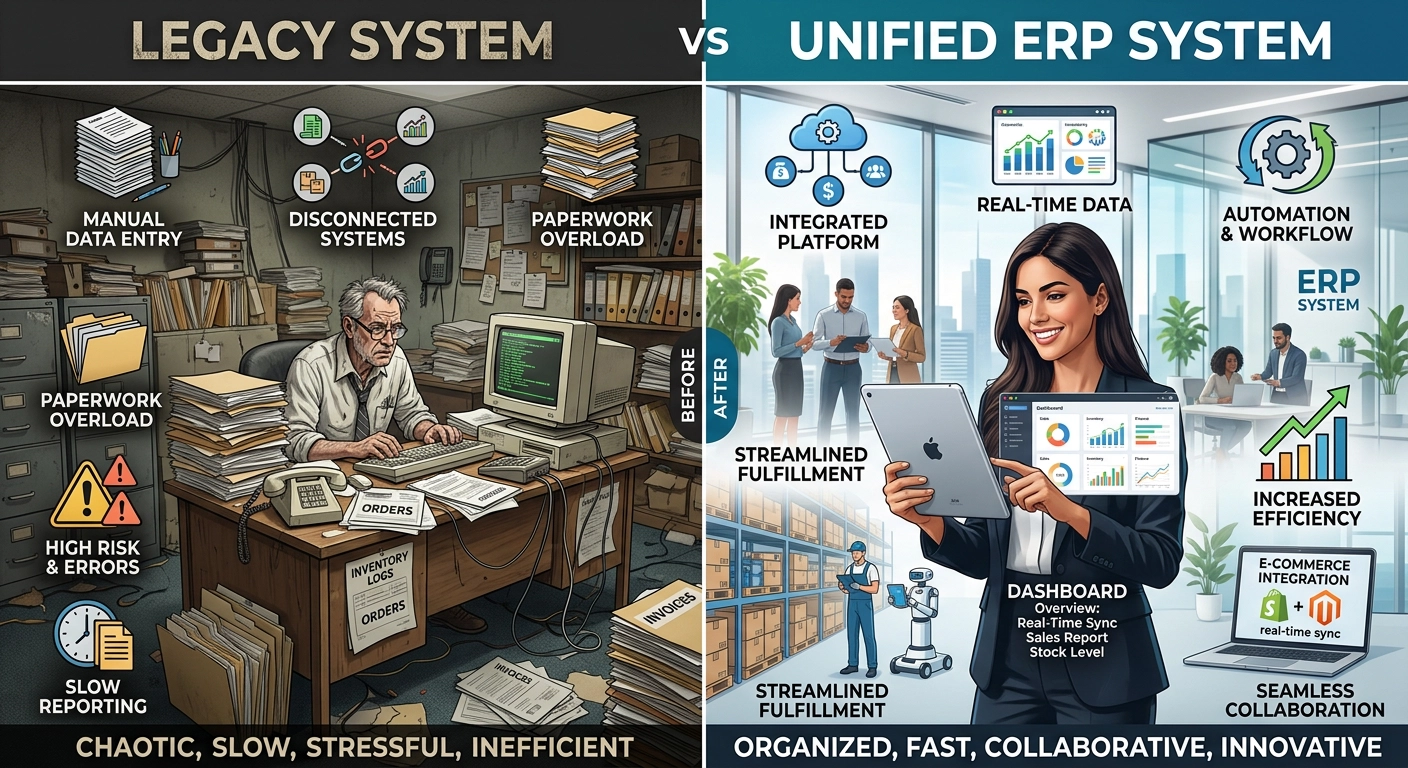
If your trade counter, field sales reps, and online storefront operate in silos, your business is losing ground. In an era defined by extreme commodity market volatility, rising operational overheads, and shifting buyer demographics, electrical wholesalers must transition from fragmented legacy applications to unified, multi-channel commerce.
Operating an electrical wholesale business in 2026 requires navigating an increasingly complex financial and digital environment. Wholesalers are caught between erratic global supply chains and a new generation of digital-native contractors who demand instant information. Survival and profitability come down to five core market forces:
When these channels and challenges do not share a single, living database, the resulting internal friction directly damages the customer experience. To capture modern buyers, scale operations efficiently, and protect fragile trade margins, wholesalers must build their businesses on an integrated enterprise resource planning (ERP) foundation.
Disconnected channels and the cost of blind operations
The modern trade buyer interacts with an electrical wholesaler across multiple touchpoints—often during a single purchasing cycle. A contractor might browse product specifications online on a tablet while on-site, call a sales representative to negotiate a bulk rate, and then drive to the physical trade counter to pick up the materials.
When your sales channels operate on separate, non-communicating databases, this multi-channel journey breaks down completely. Studies show that over 70% of B2B buyers will switch to a competitor if a supplier cannot provide consistent, real-time cross-channel inventory visibility. If your digital storefront says a specific reel of armoured cable or a pack of consumer units is "In Stock," but the counter staff just sold the last unit to a walk-in customer ten minutes prior, you face an immediate failure of customer satisfaction.
Furthermore, the rise of B2B eCommerce means your business is expected to be open 24 hours a day, 7 days a week. If an online order placed at midnight sits passively in an isolated web inbox until a counter staff member manually types it into the branch system at 8:00 AM, you have introduced an 8-hour delay into your supply chain. This fragmentation forces your team to spend their days firefighting data mismatches rather than proactively selling, while your customers experience inconsistent service that drives them toward larger, fully integrated competitors.
Copper is the lifeblood of the electrical sector, essential for everything from low-voltage twin-and-earth cables to heavy-duty industrial busbars. However, global market volatility means the base cost of copper can fluctuate rapidly in response to mining disruptions, geopolitical shifts, and green energy demands.
For a wholesaler running disconnected systems, these rapid cost updates are impossible to manage. If the London Metal Exchange (LME) copper price spikes, a wholesaler must immediately adjust their selling prices to preserve their gross margin. If those price updates are manually entered into a legacy branch system but take days to sync to the online trade portal, the wholesaler will inadvertently sell highly priced copper inventory at old, discounted rates online.
Conversely, if the market dips and your systems fail to adjust, your online prices will appear uncompetitively high, driving contractors straight to nimbler competitors. Without real-time, centralised pricing control across every digital and physical sales channel, copper price volatility acts as a direct tax on your profitability.
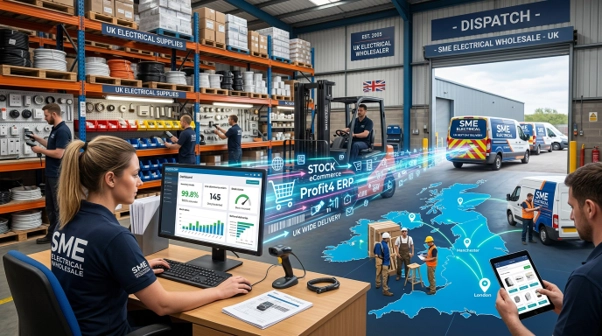
OGL Software's Profit4 eliminates channel isolation by replacing fragmented systems with a single, central repository of truth. Built specifically for stockists, distributors, and electrical wholesalers, Profit4 ensures that your physical trade counter, back-office sales team, field representatives, and online B2B eCommerce storefront access the exact same database in real time.
Electrical distribution relies on highly complex, non-standardized pricing structures. Unlike traditional retail, where a single price applies to all buyers, an electrical wholesaler might manage thousands of unique pricing variations. A single contractor may have:
Research indicates that manual price management and invoice errors cost B2B distributors up to 1% or 2% of their total gross revenues annually in leakage and administrative correction. When pricing is managed via spreadsheets or rigid legacy software, keeping track of these rules is incredibly difficult.
🛑 1% - 2% Gross revenue lost annually to pricing leakage and invoice errors.
🛑 15-20 Minutes spent resolving every single disputed trade invoice manually.
🛑 64% of Buyers will abandon an online portal if forced to call for pricing.
It's no surprise to any wholesaler or distributor that the importance and demand for an online shopping experience is continuing to grow. The lines between B2C and B2B are increasingly blurred which means that companies can no longer ignore the importance of owning an eCommerce website, even if they believe it's of a low priority to their sales pipeline.
If a counter clerk manually overrides a price because they cannot easily find a customer's specific agreement, your gross margin takes a direct hit. Alternatively, if the counter clerk charges the standard trade list price by mistake, the contractor will likely spot the discrepancy on their monthly statement. This triggers a time-consuming dispute process, forcing your accounts team to track down quotes, issue credit notes, and manually correct invoices.
This issue becomes even more acute when transitioning to eCommerce. Modern B2B buyers expect total transparency. Up to 64% of B2Bbuyers state they will abandon an online procurement portal entirely if they cannot view their specific contract pricing immediately upon logging in. If a contractor logs into your web portal at night to estimate a job and sees only standard retail pricing or a generic "Call for Price" message, they will log out and find a supplier whose system can give them an immediate, accurate answer.
Profit4 solves the complexity of trade pricing with an exceptionally flexible, multi-layered pricing matrix engine. The system handles the intricate pricing rules of the electrical trade automatically, ensuring total accuracy across every transaction, regardless of which channel the buyer prefers.
Paper trails, warehouse friction, and mis pick financial costs
The final, and often most critical, point of failure for an electrical wholesaler is the physical warehouse. In electrical distribution, products range wildly in size, shape, and storage requirements—from micro-sized terminal blocks and fragile LED lamps to heavy, bulky drums of steel wire armoured (SWA) cable. Managing this diverse inventory using manual, paper-based workflows is highly inefficient.
Industry metrics show that the average cost of a single B2B picking error ranges from £30 to over £100 when factoring in return freight, administrative processing, restocking labour, and replacement shipping. If your warehouse relies on printed pick sheets, workers waste significant time walking back and forth across the facility, deciphering messy handwriting, and searching unmapped bins for specific parts.
This manual friction severely impacts order fulfillment velocity. In 2026, contractors routinely demand just-in-time (JIT) delivery. They want to order materials from their smartphones in the afternoon and have them delivered directly to the construction site by 7:30 AM the following morning.
If your warehouse operations are slow and error-prone, you miss critical dispatch windows, leading to late deliveries. When a delivery is delayed, an electrical contractor is forced to pay qualified electricians to stand around on-site with no materials to install. This scenario destroys customer satisfaction and completely erodes long-term account loyalty.
Profit4 eliminates warehouse friction by replacing slow, paper-driven workflows with an automated, digitally directed warehouse management structure. By connecting inventory data directly to fulfillment operations, Profit4 accelerates pick speeds, virtually eliminates picking errors, and optimizes delivery logistics.

The electrical wholesale sector moves too quickly for rigid, outdated technology stacks. Relying on disconnected software silos limits your market reach, burdens your team with low-value administrative work, and risks alienating up to half of your target trade audience.
In 2026, an integrated ERP platform is no longer a luxury reserved for multi-national distributors—it is a baseline requirement for operational survival and sustained financial growth. By unifying your physical trade counter and digital storefront with a single, live database, you can confidently navigate commodity market volatility, streamline your operations, protect your hard-earned margins, and deliver the frictionless omnichannel experience modern trade buyers demand.
Don't let legacy software hold back your market potential. Discover how OGL Software can unify your operations, eliminate costly friction, and future-proof your wholesale business.
Watch our short, on-demand video demo of Profit4 today to see our industry-specific ERP software in action.