ERP Software for UK Horticulture Wholesalers and Suppliers

2026-06-12
time icon
5 mins

The 2026 UK environmental horticulture production sector is valued at £1.7 billion annually, supplying plants and trees to over 28 million domestic gardens. However, IBISWorld market data projects the average profit margin for flower and plant growers to sit tightly at 11.7%.

Key Takeaways

  • Thin margins demand efficiency: UK plant nurseries operate on a tight 11.7% average profit margin, leaving zero room for manual administrative errors or logistics guesswork.
  • Perishable and dynamic inventory: Unlike fixed goods, living plants change daily in size, quality, and saleable status, making real-time availability tracking the core commercial metric.
  • Extreme seasonal demand peaks: The spring peak (late February through May) drives intense transaction volumes that require robust, automated systems to prevent costly operational backlogs.
  • Specialised logistics and packaging: Horticulture distribution relies heavily on tracking specific transport assets, like Danish trolleys, and managing customer-specific branding and labels during dispatch.
  • Strict regulatory compliance: Systems must natively support and document UK plant passport requirements (administered by APHA) to guarantee legal traceability during transport.

Protect Your Margins in a £1.7 Billion Market

During a UK Parliament horticultural briefing, it was stated that supermarkets and major retail chains account for over 64% of the live plant distribution footprint. These buyers enforce strict "retail specifications" and automatically reject stock that deviates even slightly from size or quality parameters, which drastically diminishes returns and creates supplier waste.

A Horticultural Trades Association (HTA) operational report reveals that a striking 94% of UK commercial growers are actively planning or executing investments in automation to secure future growth.

Moving to a unified ERP like Profit4 bridges the gap between unpredictable live-goods operations and tight profit margins by replacing fragmented manual systems with a single cloud platform that automates complex product attributes, coordinates high-volume retail supply chains, and optimises delivery logistics to eliminate costly administration and protect your bottom line.
Horticultural warehouse loading bay A well organised plant nursery loading bay.

Case Study: Bransford Webbs Transition to Profit4

Supplying garden centres across the country with a wide range of high-quality ornamental plants, Bransford Webbs has built a strong reputation over more than 60 years. Now, as demand continues to grow, the company has chosen OGL Software’s innovative Profit4 ERP solution to help streamline its processes and support long-term growth.

"We explored the market, evaluating both horticultural software and broader ERP solutions. That’s when Profit4 and the team at OGL Software stood out as the ideal solution for us. The synergy between our businesses made them a natural fit, and I was impressed with how quickly OGL understood our needs and the specific requirements of the horticultural wholesale industry." — Richard Colbourne, Joint Managing Director at Bransford Webbs

Richard Colbourne (Right) of Bransford Webbs with Lyndon Bendall of OGL Software Richard Colbourne (left) of Bransford Webbs with Lyndon Bendall of OGL Software

Why Horticulture Wholesale Has Unique Software Requirements

Horticulture wholesale is unlike most other distribution sectors. The stock is alive. Availability changes not just week to week but day to day. Demand peaks sharply around key seasonal windows and drops away just as quickly. Customers — garden centres, landscapers, local authorities, nurseries — expect accurate availability information, reliable delivery, and products that arrive in the condition they were ordered.

Managing all of that with a generic ERP — or, as many horticulture wholesalers still do, with a combination of spreadsheets, availability lists, and disconnected systems — creates operational constraints that become harder to manage as the business grows.

  • Living, perishable stock behaves differently: A plant is not a widget. Its condition, quality, and sellable status change over time — and unlike other perishable goods, the stock itself is growing, changing, and in some cases deteriorating or dying.
  • Seasonality drives extreme demand variation: The spring peak — from late February through May — can represent a disproportionate share of annual revenue. Managing the operational surge requires a system that can handle high-volume periods without creating backlogs.
  • Availability, not just stock level, is the core commercial currency: Customers want to know what is available now, what is coming through in the next two to four weeks, and what can be reserved ahead of the season.
  • Transport unit management is operationally central: Plants move on Danish trolleys, CC carts, benches, and roll cages. Managing logistics at the transport unit level is an absolute requirement.
  • Customer-specific labelling is expected: Garden centres typically require specific label formats, branding, or retail-ready product presentation generated directly inside the dispatch workflow.
  • Plant passport requirements add a compliance dimension: Wholesalers moving regulated plants within Great Britain, Northern Ireland, or the EU must comply with UK plant passport requirements administered by APHA.

The Operational Landscape for UK Horticulture Wholesale

The UK horticulture sector supplies a diverse and demanding customer base. Garden centres are the most visible end market, but horticulture wholesalers also supply landscapers, local authorities, retail chains, growers, and increasingly direct-to-consumer online channels.

The market has evolved considerably in recent years. The pandemic-driven surge in interest in gardening and outdoor spaces led to a significant increase in demand that tested the operational capacity of many suppliers. Online ordering — both trade B2B portals and direct-to-consumer channels — has become an established part of the commercial landscape, with buyers expecting to access live availability and place orders outside of standard office hours.

At the same time, the sector faces ongoing structural challenges: labour availability (the Seasonal Worker Scheme provides limited and temporary relief), the impact of climate and weather variability on growing schedules, and the increasing complexity of supply chains for businesses that supplement their own growing with bought-in stock from European and other sources.

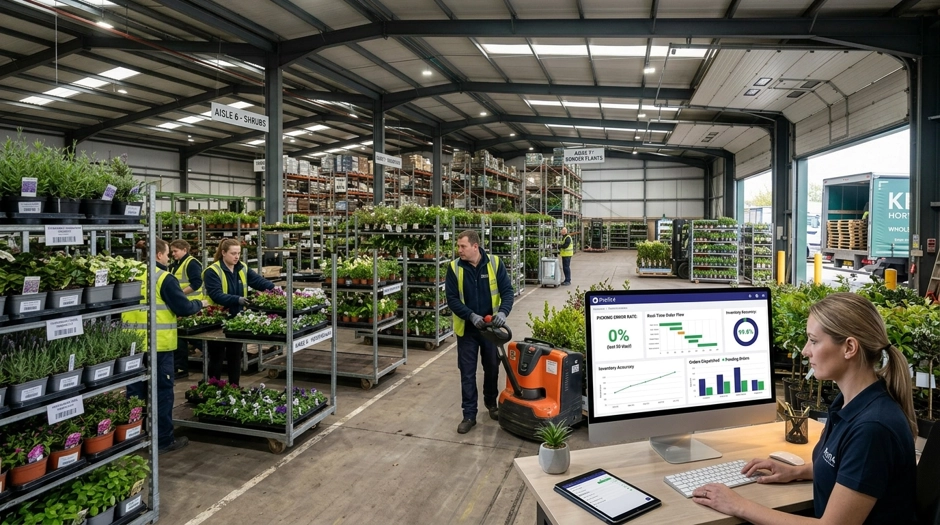
Real time inventory management across multiple channels Real time inventory management across multiple channels

Core ERP Capabilities for Horticulture Wholesale

Stock and Availability Management

In horticulture wholesale, stock management and availability management are not the same thing. Stock management tracks what you physically have. Availability management tells you what you can sell — now, and in the coming weeks — factoring in existing commitments, forward growing schedules, and quality assessments. A capable horticulture ERP manages both: current stock levels by product, variety, pot size, and quality grade; reservations and commitments against that stock; forward availability based on growing cycles; and the ability to update availability in real time as conditions change. The accuracy of your availability list is a direct measure of your commercial credibility with customers.

Seasonal and Forward Ordering

Many horticulture customers place forward orders — committing to volumes and delivery windows weeks or months ahead of the season, based on forecast availability. Managing these orders through the full lifecycle — from placement, through stock reservation as plants become available, to confirmation and scheduling — requires a system that handles forward order management natively.

The system should also give the commercial team visibility of demand against forward availability, so that overselling or under-supply situations are identified and managed before they become customer service problems rather than after.

Transport Unit and Danish Trolley Management

For horticulture wholesalers selling and dispatching on Danish trolleys, CC carts, or similar transport units, the ERP should manage sales at the trolley level — not just at the individual item level. Configuring, assigning, and visualising transport units as part of the sales and dispatch workflow keeps operations accurate and gives the logistics team the information they need to plan vehicle loading and route management.

Trolley tracking — knowing which trolleys are at which customer sites and when they are due to be returned — is an operational and asset management requirement that the system should support.
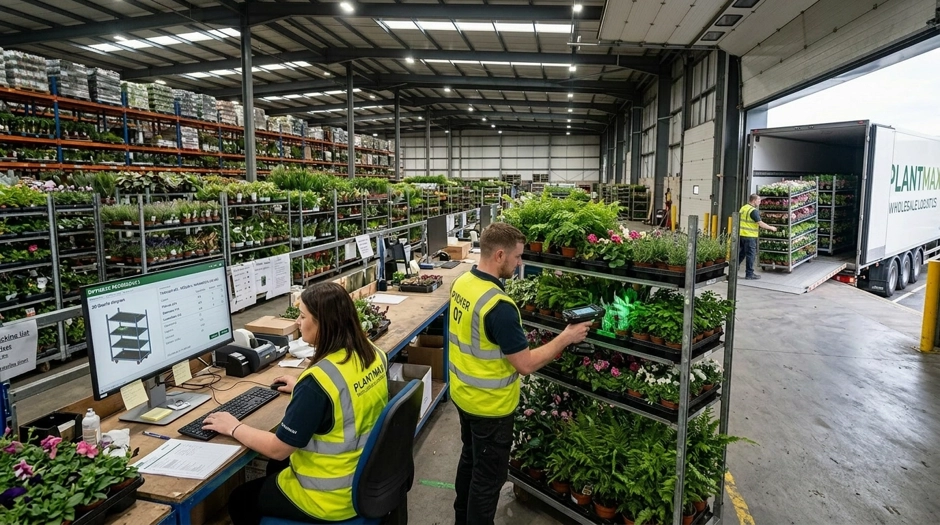
Describe image here for SEO Manage your deliveries by trolley dimensions.

Customer-Specific Labelling and Product Presentation

Garden centre customers in particular expect their supplied products to arrive retail-ready — labelled with their own branding, formatted to their shelf specifications, or carrying the product information they need for their own retail operation. Managing customer-specific label templates, assigning them to the correct products and customers, and generating labels automatically as part of the pick and pack workflow saves significant manual effort and reduces the risk of dispatch errors.

Seasonal Order Management at Pace

During peak season, the volume of orders being processed, picked, and dispatched can be multiples of the off-peak rate. A system that slows down or creates bottlenecks at high volume is a direct operational cost. The order management module needs to handle batch processing, bulk documentation, and high-speed picking workflows that keep pace with the season — not restrict it.

Plant Passport Compliance

UK plant passports are required for most regulated plants moving through the professional supply chain in Great Britain. Authorised Professional Operators must be registered with APHA, must maintain appropriate traceability records for their stock, and must issue passports correctly on every qualifying consignment.

An ERP that supports plant passport compliance keeps traceability records against stock movements, generates the required passport documentation as part of the dispatch workflow, and maintains the records needed for an APHA audit. Managing this manually — through separate spreadsheets or paper records — is increasingly impractical as volumes and product ranges grow.

Purchasing and Supply Chain Management

Horticulture wholesalers that supplement their own growing with bought-in stock — from UK nurseries, European growers, or specialist breeders — need a purchasing module that manages supplier relationships, forward ordering, import documentation, and goods receipt in a single workflow. Lead times in horticulture can be long and variable; effective forward purchasing requires the system to track commitments and expected delivery windows against demand.

eCommerce and B2B Online Ordering

The availability list — traditionally shared as a PDF or Excel file — is increasingly moving online. Customers expect to see live availability, place orders at any time, and manage their accounts through a self-service portal. A horticulture wholesale ERP with integrated B2B eCommerce gives customers a live view of current stock and forward availability, personalised with their own pricing and product range, accessible 24/7.

This is no longer a differentiator — it is an expectation among trade customers who buy from multiple suppliers and naturally favour the ones who make ordering simplest.

Accounts and Finance

Integrated accounts with seasonal cash flow management, credit control for garden centre accounts, and MTD-compliant VAT handling. For horticulture businesses with multiple trading entities or growing operations running alongside distribution, the accounts module needs to handle that complexity without requiring parallel systems.

Questions to Ask When Evaluating ERP for Horticulture Wholesale

  1. Does the system manage forward availability separately from current stock, and can customers see that through a B2B portal? This is the most fundamental operational requirement for horticulture wholesale. If the answer is unclear, the system is not sector-specific.
  2. How does the system handle transport unit management — Danish trolleys, CC carts, and similar? This question will quickly reveal whether a vendor understands horticultural logistics or is describing a generic WMS.
  3. Can the system produce customer-specific labels as part of the pick and pack workflow? If this requires a manual step or a separate label management system, it will create problems at peak volume.
  4. How does the system support plant passport compliance and APHA traceability requirements? Horticulture-specific regulatory compliance should be built into the workflow, not managed around it.
  5. Can you provide references from UK horticulture wholesale businesses using the system? Real sector experience should be demonstrable, not just claimed.

How Profit4 Supports UK Horticulture Wholesalers

Profit4 by OGL Software is a cloud-based ERP with a growing presence specifically in UK horticulture wholesale. The platform's horticulture capability has been shaped directly through collaboration with sector businesses — most notably Bransford Webbs, one of the UK's leading ornamental plant wholesalers supplying garden centres nationwide, who chose Profit4 after evaluating both specialist horticultural software and broader ERP solutions.

That partnership has driven specific development across the capabilities that matter most to horticulture wholesale businesses: stock reservation at the point of sales line completion, transport unit configuration and visualisation (including Danish trolleys), customer-specific labelling and label printing, forward availability management, and the operational workflows that support high-volume peak season trading.

Profit4 replaces the patchwork of legacy systems, spreadsheets, and availability lists that many horticulture wholesalers still rely on — with a single, integrated platform that connects stock, orders, logistics, accounts, and customer management.