
Your complete guide to small business inventory management
Inventory management isn't just an issue for the largest wholesalers and stockists. Learn more about small business inventory management in our guide...

With 50 years' experience in the wholesale and distributor sector, we have put together a 14-page guide on the key facts about ERP. Download yours for free.





UK plant passports have been a legal requirement for the movement of most regulated plants through the professional supply chain since the end of the EU transition period. For horticulture wholesalers operating across Great Britain, supplying garden centres, landscapers, local authorities, and other professional operators, plant passport compliance is not optional and not peripheral. It sits at the centre of the supply chain.
Yet for many smaller and mid-sized horticulture wholesale businesses, the practical management of plant passport requirements still relies heavily on manual processes: paper records, spreadsheet tracking, and labels produced outside the order management workflow. As volumes grow and regulatory scrutiny increases, those manual approaches become harder to sustain — and the risk of non-compliance becomes more significant.
This article explains what UK plant passport requirements mean in practice for horticulture wholesalers, why your ERP system needs to support them, and what a compliant, system-integrated approach looks like.
 Plant passports for horticulture wholesalers
A UK plant passport is a label or document that must accompany regulated plants as they move through the professional supply chain in Great Britain. It acts as a conformity document, providing assurance that the plants concerned have undergone the necessary checks to confirm they are free from regulated pests and diseases and meet UK plant health standards.
Who is required to issue plant passports?
Any business that sells or transfers regulated plants to another professional operator — wholesalers, nurseries, landscapers, retailers — must be authorised to issue UK plant passports. Authorisation is granted by APHA (the Animal and Plant Health Agency) and must be renewed annually. The annual renewal process requires businesses to confirm the genera they grow, buy in, or trade, acting as a regular prompt to review plant health responsibilities.
What plants require passports?
The list of regulated plants that require UK plant passports covers a wide range of species commonly traded in the ornamental and food production sectors — including many of the most commercially significant lines in horticulture wholesale. The specific list is maintained by APHA and is updated periodically as new pest or disease threats are identified. Horticulture wholesalers are responsible for understanding which of their products are regulated and ensuring passports are issued correctly for every qualifying consignment.
When are passports not required?
Direct retail sales to members of the public paying in person at a fixed point of sale do not require plant passports. However, if you sell directly to garden centres (even if they are also retailers), you must issue passports because you are supplying a professional operator. Online sales direct to the public — including mail order — do require passports.
Plant passports are not simply a labelling requirement — they are underpinned by a traceability obligation. To be authorised to issue plant passports, a business must maintain adequate records to demonstrate the origin of its stock, its movements through the supply chain, and the basis for the plant health assurances given in the passport.
This traceability requirement means that for every regulated plant consignment dispatched, the business should be able to answer:
What is an APHA plant passport audit?
APHA conducts periodic audits of authorised businesses and will examine records to verify that the passport system is working as intended. A business that issues passports but cannot produce adequate traceability records is at risk of having its authorisation suspended or revoked — with serious commercial consequences. When APHA inspectors audit an authorised professional operator, they conduct interviews, physically sample host plants for pests, and extensively review the company's records. They look for an unbroken digital or physical trail of every plant that has entered or left the facility.
 Combining Plant Passport details with dispatch notes in Profit4
Many horticulture wholesale businesses manage their plant passport obligations manually — producing passport labels outside their main business system, maintaining traceability records in spreadsheets, and relying on the knowledge and diligence of individual staff members to ensure compliance. This approach has several inherent weaknesses:
Passport production is a separate manual step.
When passport labels are generated outside the order management workflow — as a separate process, by a separate person, after the pick is prepared — there is a risk that consignments are dispatched without a valid passport, or with an incorrect one. At high peak-season volumes, this risk increases substantially.
Traceability records are incomplete or hard to interrogate.
A spreadsheet that records which batches of stock were received from which supplier, and which customers received which stock, is a legitimate traceability tool — but only if it is maintained consistently and accurately, and only if the information can be retrieved quickly when needed. In practice, spreadsheet-based traceability records are often partial, inconsistently maintained, and slow to interrogate under time pressure.
Staff dependency creates vulnerability.
If the person who manages plant passport records is absent during peak season, or leaves the business, the institutional knowledge they carry about how the system works is not necessarily documented or accessible to anyone else. This is a compliance risk that a system-based approach eliminates.
Scaling the business increases the exposure.
A manual passport management process that works adequately for a small number of lines and a modest customer base becomes progressively harder to sustain as the product range, customer base, and order volumes grow. The operational cost of maintaining compliance manually scales with the business; a system-based approach does not.
When plant passport compliance is integrated into the ERP — rather than managed alongside it — the compliance workflow becomes part of the standard order and dispatch process, not a separate obligation managed in parallel.
Stock traceability from goods receipt.
When bought-in stock is received from a supplier, the ERP records the origin, batch or lot reference, supplier plant passport details (if applicable), and any relevant plant health information as part of the goods receipt process. This creates the upstream traceability record that supports passport issuance.
Passport data linked to product records.
Products that require passports are identified within the system, with the relevant passport information — authorised operator registration, country or region of origin, variety information — held against the product record and updated when the stock changes origin or status.
 The Plant Passport process in Profit4
Passport generation as part of dispatch.
When a consignment is prepared for dispatch, the system generates the required plant passport label or documentation automatically, drawing on the product and traceability records already held in the software. The passport is produced as part of the standard dispatch workflow — not as a separate step that can be forgotten or deferred.
Audit trail for APHA inspection.
The system maintains a complete record of every consignment dispatched with a passport — including the product, origin, destination, date, and passport reference. This is the record that supports an APHA audit, and it is generated automatically from operational data rather than maintained separately.
If APHA identifies a pest interception in material supplied by one of your upstream suppliers, the system can rapidly identify which of your own customers received stock from that source — allowing you to notify them promptly and demonstrate that the supply chain has been managed appropriately.
The annual renewal of plant passport authorisation via eDomero is a regulatory reminder as much as an administrative task. It requires businesses to confirm the genera they are authorised to passport, ensuring that the authorisation accurately reflects the range of regulated stock being traded. For horticulture wholesalers whose product range changes year to year — adding new varieties, taking on new product categories, or changing supplier relationships — the annual renewal is an opportunity to review whether the authorisation is current. An ERP that maintains a complete record of the genera in your product catalogue, and their regulated status, makes this review straightforward rather than a retrospective exercise.
 Bransford Webbs own groing areas
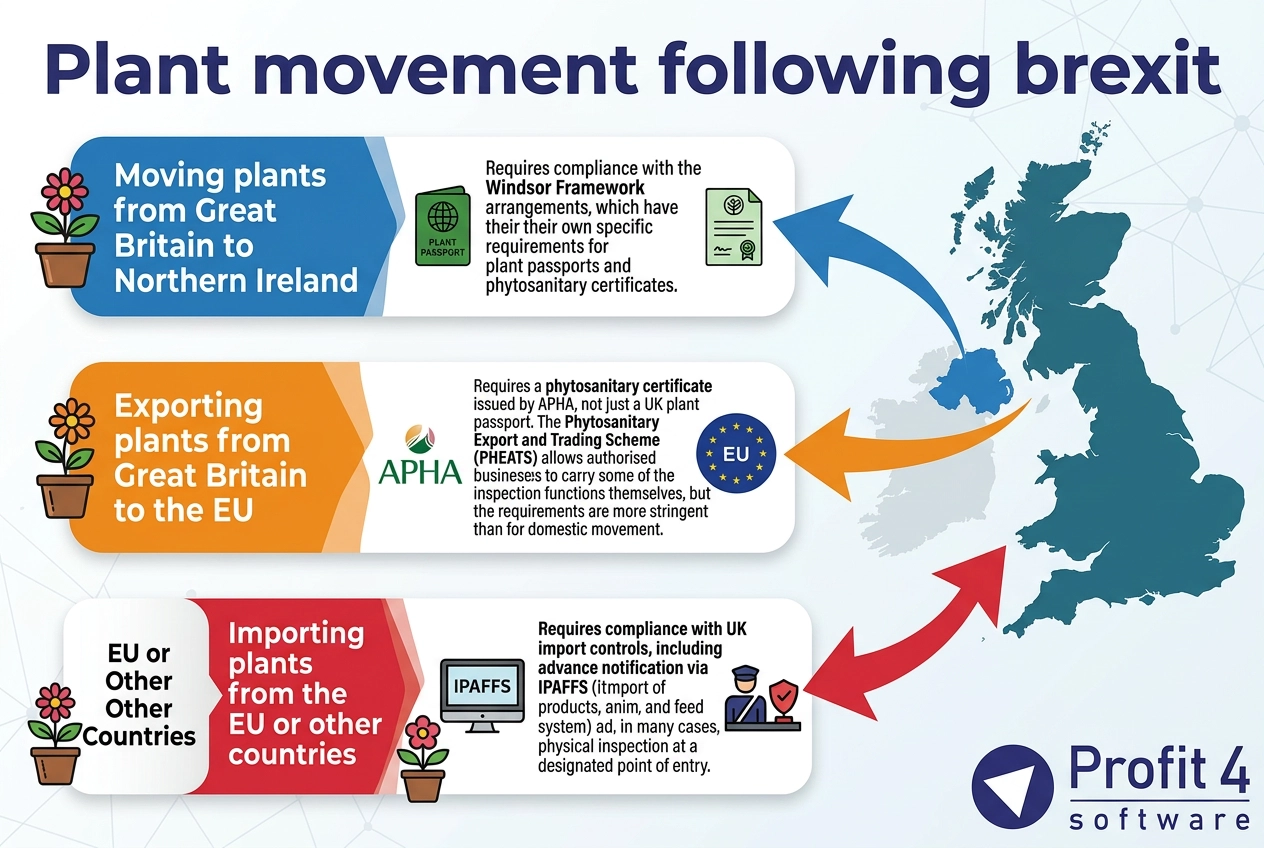 Infographic showing legal requirements for plant export from the UK
For horticulture wholesalers with any element of cross-border trade, plant health requirements have become considerably more complex since Brexit.
Moving plants from Great Britain to Northern Ireland
Requires compliance with the Windsor Framework arrangements, which have their own specific requirements for plant passports and phytosanitary certificates.
Exporting plants from Great Britain to the EU
Requires a phytosanitary certificate issued by APHA, not just a UK plant passport. The Phytosanitary Export and Trading Scheme (PHEATS) allows authorised businesses to carry out some of the inspection functions themselves, but the requirements are more stringent than for domestic movement.
Importing plants from the EU or other countries
Requires compliance with UK import controls, including advance notification via IPAFFS (the Import of products, animals, food and feed system) and, in many cases, physical inspection at a designated point of entry.
An ERP that supports plant health documentation as part of its international trade functionality — including export documentation, import notifications, and the associated traceability records — reduces the manual burden of cross-border compliance significantly.
Beyond regulatory compliance, plant passport management reflects something commercially important: the traceability and quality assurance standards of the business. Garden centres, landscape companies, and other professional buyers that take supply chain compliance seriously increasingly use it as a criterion for supplier selection. A horticulture wholesaler that can demonstrate full traceability, consistent passport compliance, and an audited approach to plant health is a more attractive supply partner than one whose compliance record is uncertain.
For horticulture wholesalers seeking to grow their customer base — particularly into larger accounts, public sector contracts, or garden centre groups with their own compliance requirements — having the systems and records to demonstrate compliance is a commercial asset, not just a regulatory obligation.
Profit4's stock traceability infrastructure, integrated with dispatch workflows and document generation, provides the operational foundation for plant passport compliance in horticulture wholesale. Stock traceability from goods receipt, passport documentation generated as part of the dispatch process, and complete audit trail generation give horticulture wholesalers the system support to manage their APHA obligations accurately and efficiently.
To see how Profit4 supports plant passport compliance in your horticulture wholesale operation, book a demo with our team.

Head of New Business Development at OGL Software ERP Software for Stockists, Distributors and Merchants | Designed, Developed and Supported in the UK

