
Enhanced Customer Experience on the Road
ROAD is a new a mobile app developed to work alongside prof.ITplus, to help your employees better serve your customers and your business.

With 50 years' experience in the wholesale and distributor sector, we have put together a 14-page guide on the key facts about ERP. Download yours for free.





According to data from the Horticultural Trades Association (HTA), sales of core gardening products begin climbing rapidly between February and March before peaking sharply in May. Sales then steadily decline each month through to the end of the year.
Supply and demand fluctuate wildly based on British weather. For instance, an unseasonably cold and wet spring can flatten demand (e.g., dampening plant sales), while a warm, sunny spring can cause massive, unexpected demand spikes—such as a 23% year-on-year sales spike in March during a sunny period. Wholesalers require ERP systems with real-time stock allocation to adjust instantly to these weather swings.
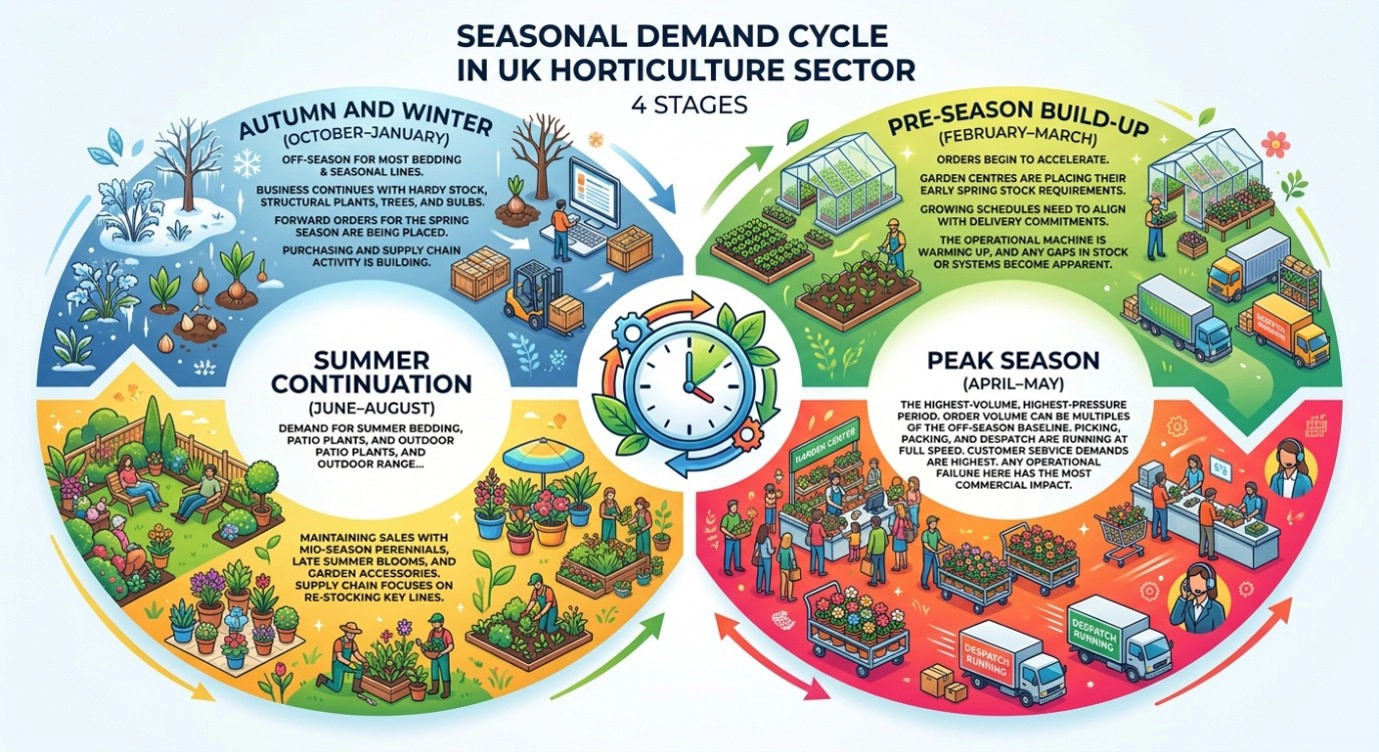 Seasonal peaks and troughs in UK horticulture
For most wholesale businesses, demand is broadly predictable month to month, varying within a manageable range. For horticulture wholesalers, seasonality is not a variation — it is the defining feature of the commercial year. The spring peak, running roughly from late February through to the end of May, can represent the majority of annual revenue, compressed into a window of weeks. Getting that window right — or getting it wrong — shapes the financial year.
The operational challenge is stark. In the quiet months, your team and your systems cope with a manageable flow. As spring approaches, demand accelerates rapidly. Orders climb, picking volumes increase, dispatch operations are running at full capacity, customer communications are intense, and the margin for error is low because any failure at this point — a missed order, an incorrect dispatch, a stockout on a bestselling variety — happens at the worst possible time.
This article examines how ERP software helps UK horticulture wholesalers manage the seasonal demand cycle — from the planning and forward ordering that happens months before the peak, through the operational intensity of the spring rush, to the post-season analysis that informs the following year.
Understanding the seasonal pattern is the starting point. For UK horticulture wholesalers, the typical demand profile looks broadly like this:
Autumn and winter (October–January):
Off-season for most bedding and seasonal lines. Business continues with hardy stock, structural plants, trees, and bulbs. Forward orders for the spring season are being placed. Purchasing and supply chain activity is building.
Pre-season build-up (February–March):
Orders begin to accelerate. Garden centres are placing their early spring stock requirements. Growing schedules need to align with delivery commitments. The operational machine is warming up, and any gaps in stock or systems become apparent.
Peak season (April–May):
The highest-volume, highest-pressure period. Order volume can be multiples of the off-season baseline. Picking, packing, and dispatch are running at full speed. Customer service demands are highest. Any operational failure here has the most commercial impact.
Summer continuation (June–August):
Demand for summer bedding, patio plants, and outdoor ranges. Intensity is lower than spring peak but remains elevated compared to winter. Second-wave planning for autumn lines begins.
Autumn transition (September–October):
Seasonal transition. Some lines clearing, new lines coming through. Forward ordering for winter and next spring beginning again.
Each phase has different operational priorities and different demands on the ERP. A system that works adequately in the off-season but struggles under peak volume creates real commercial problems.
Most horticulture wholesalers using legacy software or manual processes experience predictable failure points when the season accelerates.
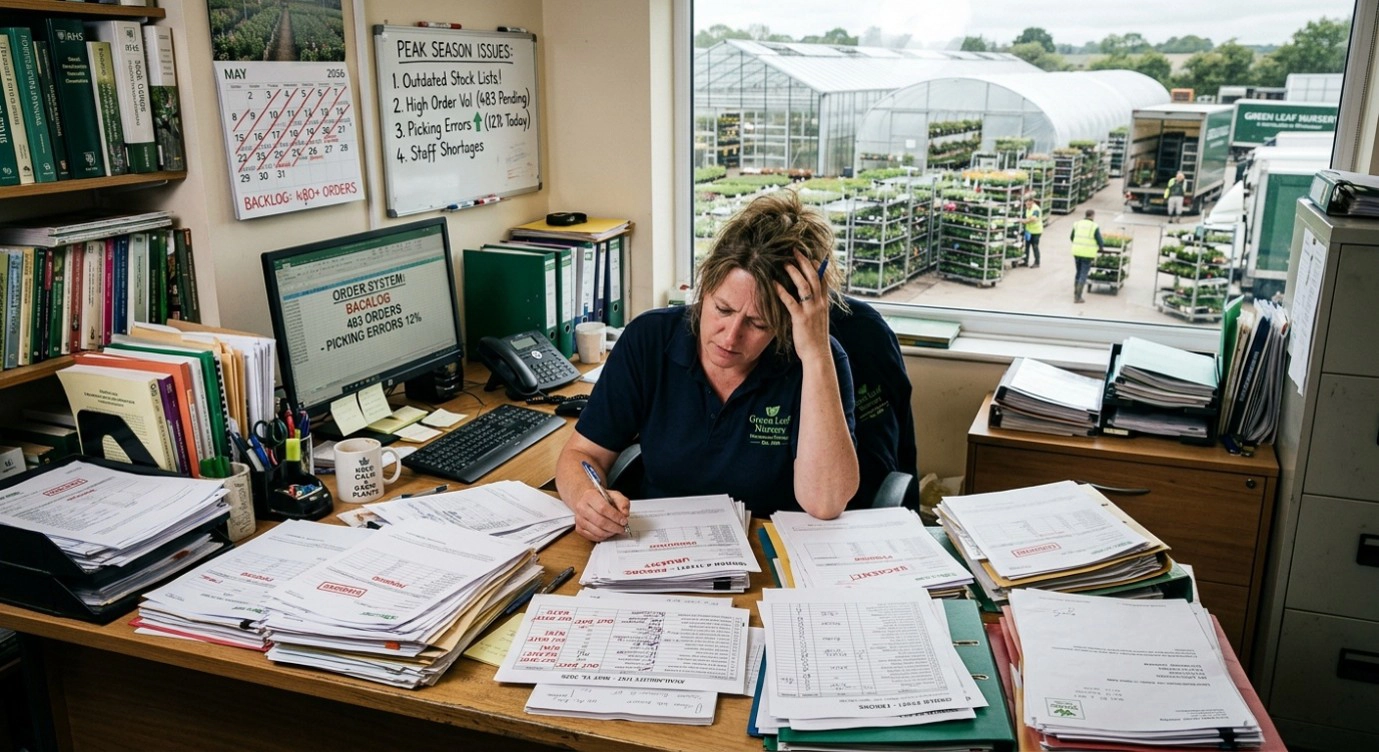 Manual processes add frustration, complications and errors
Availability lists become unreliable.
When availability is managed in a spreadsheet — manually updated by the sales team or office staff — it falls behind reality during peak periods. Overselling occurs because the list shows stock as available after it has already been committed. Customers who ordered based on that availability are then disappointed when their delivery is short or delayed. Trust erodes, and the phone rings with complaints at the busiest possible moment.
Order processing creates a backlog.
At high order volumes, a system that processes orders slowly or requires multiple manual steps to confirm, pick, and invoice creates a queue. That queue stretches lead times and, in the worst cases, means orders placed late in the week miss the planned delivery run.
Picking errors increase.
Under pressure, the warehouse team is moving fast. Without a system that guides and verifies picks, by variety, pot size, quality grade, and quantity…error rates increase. The wrong plant goes to the wrong customer. Returns happen. Credits are issued. The season's margin takes a hit.
Dispatch documentation falls behind.
Delivery notes, plant passports, and customer-specific documentation need to accompany every delivery. When these are produced manually — or are dependent on an office team that is also handling a spike in orders and enquiries — they become a bottleneck that delays dispatch.
Cash flow visibility suffers.
In a high-volume period, the gap between dispatch and invoice can widen if the order management and accounts systems are not integrated. Revenue is going out the door faster than it is being recorded, and the management team is making decisions with incomplete financial information.
Run your current operational setup through this quick diagnostic checklist. If you recognise two or more of these issues, your systems are highly vulnerable to breaking during the next seasonal demand spike.
Sales & trade Portals
Warehouse & greenhouse picking
Logistics & compliance
A purpose-built horticulture wholesale ERP addresses these failure points by design — automating the processes that break under manual management and giving the entire team real-time visibility of what is happening across the business.
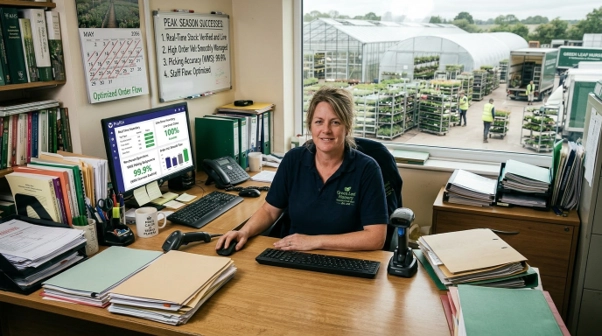 ERP Software brings real time visibility
Real-time availability management
The availability list is no longer a separately maintained document — it is a live view of current stock and committed orders within the system. As each sales line is confirmed, the system automatically reserves the stock against that order, updating availability in real time. The next customer to enquire sees an accurate picture, not one that is hours or days out of date. This eliminates the overselling problem at the source. Sales staff can quote availability with confidence. Online ordering customers see live stock positions. And the panic of discovering that the same variety has been sold twice to different customers does not happen.
High-volume order processing
A well-designed horticulture ERP is built to handle large order volumes without slowing down — processing orders in batches, generating pick lists efficiently, and producing dispatch documentation automatically. Bulk order operations — merging, splitting, batch-confirming — are available to the sales team without requiring manual processing of each order individually. During peak season, the ability to process a large volume of orders quickly and accurately is a direct competitive advantage. Customers whose orders are confirmed and dispatched promptly are customers who are satisfied; customers who are chasing late order confirmations are customers looking at alternatives for next season.
Guided warehouse picking
A WMS module configured for horticulture workflows guides warehouse operatives through the pick — directing them to the right location, the right variety, the correct quantity and quality grade, and verifying via barcode scan that the correct product has been selected. Pick routes are optimised to reduce travel time within the growing area or warehouse. During the spring peak, when the warehouse is moving at its fastest pace, a system that prevents errors before they happen is worth considerably more than one that requires corrections after the fact.
Automated dispatch documentation
Delivery notes, plant passport documents, and any customer-specific documentation are generated automatically from the order and dispatch record — without a separate manual step. For horticulture wholesalers producing high daily dispatch volumes during peak, this is not a marginal efficiency saving; it is an operational necessity.
Integrated invoicing
In a fully integrated ERP, the dispatch confirmation triggers the invoice automatically. Revenue is recorded in real time. The accounts team has an accurate view of outstanding balances and cash flow throughout the season, not a picture that is perpetually catching up with the warehouse.
The operational success of the spring peak is determined as much by what happens in the preceding months as by what happens during the peak itself. ERP software supports the planning phase in several important ways.
 Forward planning with ERP software to ease pressure
Forward order management
Capturing customer pre-season commitments — orders placed in autumn and winter for spring delivery — gives the commercial and production teams the information they need to plan growing schedules, purchasing, and capacity. A system that manages forward orders through the full lifecycle (from placement to reservation to confirmation) gives planners visibility of committed demand before the season begins. Forward orders also give customers confidence. A garden centre that has pre-committed to a volume of a specific variety, and received confirmation that stock is being held for them, is a customer that plans their season around your supply. That relationship is worth protecting.
Purchasing and supply chain planning
For horticulture wholesalers buying in stock to supplement their own growing, the purchasing module needs to reflect seasonal demand patterns. Automated reordering, supplier lead time tracking, and planned purchase scheduling — driven by the forward order book and the growing calendar — keep the supply chain aligned with expected demand rather than reacting to it after it materialises.
Capacity and resource planning
Peak season places demands not just on stock but on picking capacity, vehicle availability, and delivery scheduling. The system's order book provides a forward view of dispatch volumes by week, allowing the operations manager to plan staffing, vehicle requirements, and route scheduling before the pressure arrives — not during it.
The season's data is one of the most valuable assets a horticulture wholesale business holds. Which varieties sold quickly and at what margin? Which customers grew significantly and which declined? Where did stockouts occur, and what was the commercial cost? Where did picking errors peak?
An ERP with a capable analytics and reporting module surfaces this analysis from the data that was generated automatically during the season, without requiring manual assembly of reports from multiple systems. ERP systems like Profit4 also have AI insight tools, allowing you to interrogate your data in a conversational way, further uncovering trends and insights for your business.
The commercial team can review variety performance and inform next year's growing plan. The operations manager can identify process improvements for the following peak. The sales team can target customers whose order volumes represent a growth opportunity.
This closed loop, operating, capturing data, analysing, improving, is how horticulture wholesalers build operational resilience over time. The ERP is the tool that makes it possible at scale.
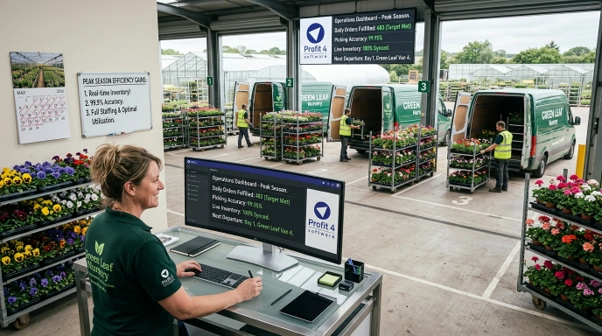 Real time visibility and planning
Profit4's real-time availability management, automatic stock reservation at point of order, high-volume order processing, guided warehouse picking, and automated dispatch documentation are all designed to support the operational demands of peak season horticulture wholesale. The platform's horticulture capability has been developed in direct collaboration with sector businesses, including Bransford Webbs, whose peak season operational requirements shaped specific features within the system.

Head of New Business Development at OGL Software ERP Software for Stockists, Distributors and Merchants | Designed, Developed and Supported in the UK
