Stand Out from Other Plumbing Distributors
We believe enhancing and improving customer service is the key driver for success in the plumbing industry. Find out more here.

With 50 years' experience in the wholesale and distributor sector, we have put together a 14-page guide on the key facts about ERP. Download yours for free.




Special price agreements and supplier rebates are a significant feature of how electrical wholesale businesses operate commercially. Handle them well, and they protect margin, reward volume purchasing, and build stronger supplier relationships. Handle them poorly, through spreadsheets, manual tracking, or a system that doesn't understand the complexity, and you're either leaving money on the table or carrying financial risk you're not fully aware of.
 Automate pricing, SKU and rebate complexity in one system..
This article explains how SPAs and rebates work in the context of electrical wholesale, why they create a specific software challenge, and what purpose-built ERP systems do to manage them correctly.
A special price agreement (SPA) is a pricing arrangement between an electrical wholesaler and a manufacturer or supplier that allows the wholesaler to sell a specific product, or product range, to a specific customer or project at a price below the standard list price.
The typical mechanics work like this: a wholesaler wins a contract or identifies an opportunity with a customer that requires competitive pricing on a particular product. They apply to the relevant manufacturer for a special price. The manufacturer agrees to a specific price for a defined period or project. The wholesaler can then sell at a competitive margin, knowing the manufacturer will support the difference.
In practice, Special Pricing Agreements for electrical distributors vary considerably in structure:
An electrical wholesaler with an active customer base and broad product range may be managing hundreds of active SPAs at any one time. Without electrical wholesale pricing software to handle these, branch-level SPA margin protection becomes impossible to enforce.
Supplier rebates are retrospective payments made by manufacturers or electrical buying groups to wholesalers, based on the volume or value of purchases made over a defined period, typically quarterly or annually.
Rebates are a meaningful part of the financial model for many UK electrical wholesalers. They're not a bonus, they're a planned element of margin that needs to be tracked, accrued for, and claimed accurately. An electrical wholesaler that doesn't have reliable visibility of its rebate position is operating with incomplete financial information.
Common types of rebates in electrical wholesale include:
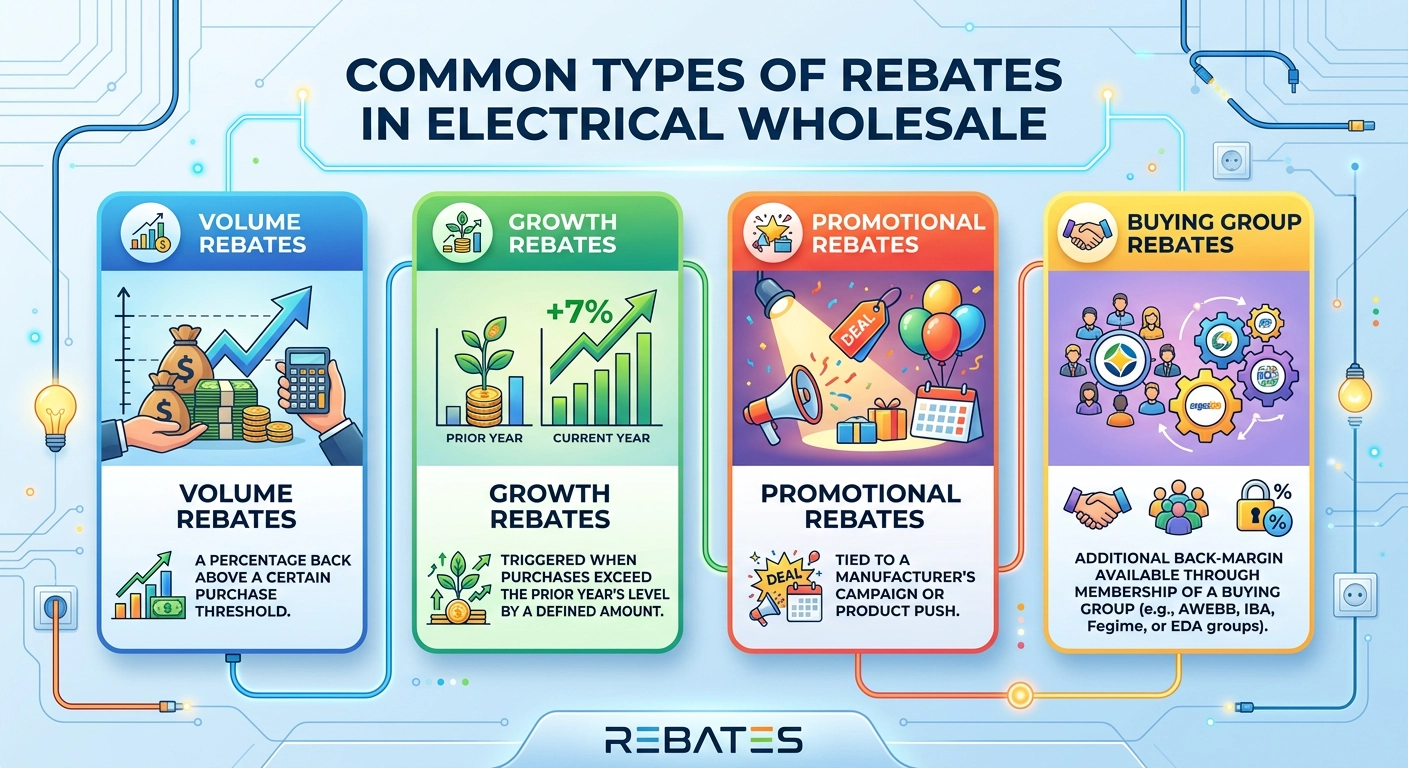 Common rebates in electrical wholesale.
Many electrical wholesalers, particularly those that haven't yet moved to a purpose-built ERP, manage their SPAs and rebates through a combination of spreadsheets, shared documents, and individual knowledge held by experienced members of staff. The problems with this manual approach are significant, predictable, and can directly damage customer service.
SPAs applied inconsistently
Without a system that automatically identifies and applies the correct SPA at the point of sale, trade counter staff and internal sales teams must remember or look up the right price for each customer or project. This can cause errors in both directions: giving away margin where no SPA applies or charging standard pricing where an SPA should be used.
Expiry dates missed
SPAs are time-limited. When they expire, and the system isn't updated to reflect that, you can find yourself selling at a margin that's no longer supported by the manufacturer, and you are absorbing a loss that wasn't anticipated. This creates massive wholesale stock valuation complications during year-end audits.
Rebate accrual is approximate
If rebate agreements aren't tracked against actual purchases in real-time, the figure in your accounts at any given point is an estimate at best. At the end of a rebate period, the reconciliation process is labour-intensive and carries a real risk of inaccuracy, which means either claiming less than you're owed or creating a liability you weren't expecting.
The risk scales with the business
The more active SPAs and rebate agreements in play, the greater the exposure of a manual management approach. A growing electrical wholesaler that has successfully managed this informally will eventually reach a point where the system breaks.
 Manual tracking of rebates and SPA's is unreliable
An SPA management ERP for an electrical distributor treats SPAs as a first-class feature, not an afterthought. The difference is in how the system handles the full lifecycle — from agreement setup through to claim and reconciliation.
Structured SPA setup & technical data attributes
Each SPA is entered into the system with its full parameters: which products or product groups it applies to, which customer or project, the agreed price or discount, the start and end date, and the manufacturer reference. This becomes the single source of truth. Advanced systems match these agreements against essential technical data attributes like ETIM Classifications and EDA data to ensure the exact SKU (matching precise dimensions or IP ratings) triggers the contract price.
Automatic price application at the point of sale
When a transaction is raised that qualifies for an active SPA, the system applies the correct price automatically. The trade counter operative doesn't need to remember the agreement or look it up — the right price appears because the system knows the customer, the product, and the date. Margin is protected by default.
Expiry management & margin protection
The system tracks SPA end dates and flags approaching expiries, giving the purchasing or sales team time to renew, renegotiate, or adjust pricing before the agreement lapses. Margin-lock alerts can be configured to block the system from selling below a true net-net cost if a contract expires.
Automated SPA claim generation
For manufacturer-funded SPAs, the ERP tracks the difference between the special price charged to the customer and the standard price, accumulating the claim liability. At the appropriate interval, it can generate a claim document ready to send to the manufacturer, with full transaction detail to support the claim, bypassing manual processes to claim back manufacturer rebates.
Automating supplier rebates in electrical wholesale follows a similar logic: the agreement is structured, performance is tracked in real-time, and accruals and reconciliation are handled systematically rather than manually.
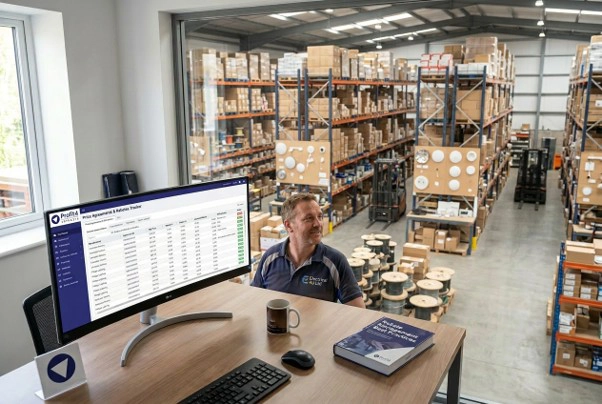 Automatic management of complex rebates in Profit4
SPAs and rebates are the most visible pricing complexity in electrical wholesale, but they sit within a broader pricing structure that an electrical wholesale ERP with contract pricing software must handle:
Electrical contractors frequently encounter the friction caused by poor system administration. When a wholesaler’s ERP lacks real-time net price calculators, contractors experience trade counter friction, leading them to search for troubleshooting solutions online:
By deploying an automated system, your business answers these pain points at the point of sale. Contractors never have to worry about a wholesaler not applying an agreed contract price or dealing with wrong batch pricing on an LED panel order. The trade counter experience becomes fast, accurate, and transparent. This delivers financial growth and increases customer loyalty.
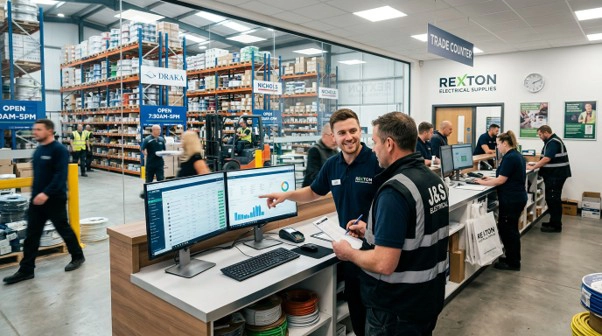 Automatic management of complex rebates in Profit4
The margin in electrical wholesale is not generous. The ability to buy well, sell at the right price, and claim back every penny of manufacturer support you're entitled to is material to the profitability of the business.
An ERP that manages SPAs and rebates correctly doesn't just reduce administrative burden, it protects and improves margin in ways that show up in the P&L. The businesses that track these agreements manually are operating with a structural disadvantage: slower, less accurate, and more exposed to margin erosion than those whose systems handle it automatically. Read more on the pricing matrix capabilities of Profit4 here.
Profit4 includes a purpose-built pricing engine designed for the complexity of electrical wholesale, handling SPAs, rebate agreements, customer pricing, volume breaks, and project pricing within a single integrated platform. Every sale draws on the correct pricing automatically; every SPA and rebate is tracked against actual activity; claims are generated from system data rather than assembled from spreadsheets.
A real-world example of Profit4’s abilities are captured in this case study of TAPPS
When launching his new venture without any legacy software in place, Julian evaluated several market options before selecting OGL’s Profit4 platform. A primary driver behind his choice was the operational simplicity that the system offered a start-up business. By centralising inventory control, logistics, CRM data, and billing within Profit4, he freed up critical time to dedicate entirely to client satisfaction.
Julian noted: "Having previously balanced disconnected systems to manage customer records, adjust price files, and dispatch invoices, I knew firsthand how slow and error-prone manual workflows can be. A new start-up simply cannot survive on inefficient administration. Today, Profit4 gives us instant access to everything we need—from automated, real-time supplier pricing updates to immediate invoice generation."
What is a Special Price Agreement (SPA) in electrical wholesale?
A Special Price Agreement (SPA) is a contract between an electrical wholesaler and a manufacturer. It allows the wholesaler to sell specific products to a designated customer or project below standard trade matrix pricing. The manufacturer then covers the margin deficit, typically through a retrospective claim process.
How do electrical wholesalers claim back manufacturer rebates?
Wholesalers claim back manufacturer rebates by tracking all qualifying purchases or sales transactions within a specific period. This data is compiled into a reconciliation report and sent to the manufacturer as a claim. Purpose-built ERP software automates this by matching sales data directly against active rebate contracts to create automated, audit-ready claims.
How does an ERP ensure UK VAT compliance on supplier rebates?
UK VAT compliance requires wholesalers to correctly account for tax adjustments on retrospective rebate payments. Because rebates reduce the original cost of the goods, a purpose-built ERP automatically generates credit notes or adjusts the input tax records. This ensures that your financial ledgers exactly match HMRC requirements for retrospective discounts.
What is the difference between matrix pricing and an SPA?
Matrix pricing is a permanent baseline pricing structure that maps customer tiers (e.g., small contractors vs. national accounts) to product categories based on buying power. An SPA is a temporary, highly specific deviation from that matrix, usually negotiated for a single project or a single customer account with manufacturer backing.
Can an electrical wholesale ERP block sales below net-net cost?
Yes. Advanced electrical wholesale ERP software features built-in margin-lock alerts. If an SPA expires or trade counter staff manually override a quote, the system automatically calculates the true net-net cost (including rebates). If the sale falls below this threshold, the system blocks the transaction until authorised by a manager.
How does Luckins' data integration prevent pricing errors?
Luckins data integration automatically syncs live manufacturer trade price lists directly into your ERP. This ensures that your baseline matrix pricing, quantity breaks, and active SPAs are always calculated against the most accurate, up-to-date market costs, preventing trade counter overcharges.
Why do electrical contractors experience pricing discrepancies at the trade counter?
Contractor pricing discrepancies usually happen when a wholesaler relies on manual spreadsheets. If an agreed contract price or project-specific SPA isn't manually updated in the system, the trade counter terminal defaults to standard list prices. This causes friction and forces contractors to question why they are being overcharged on quotes.

ERP Software consultant at OGL Software ERP Software for Stockists, Distributors and Merchants | Designed, Developed and Supported in the UK