
How FAQs Can Improve Customer Service
An FAQ page allows you to address the frequently asked questions your customers have. Learn how having an FAQ section can help customer service.

With 50 years' experience in the wholesale and distributor sector, we have put together a 14-page guide on the key facts about ERP. Download yours for free.



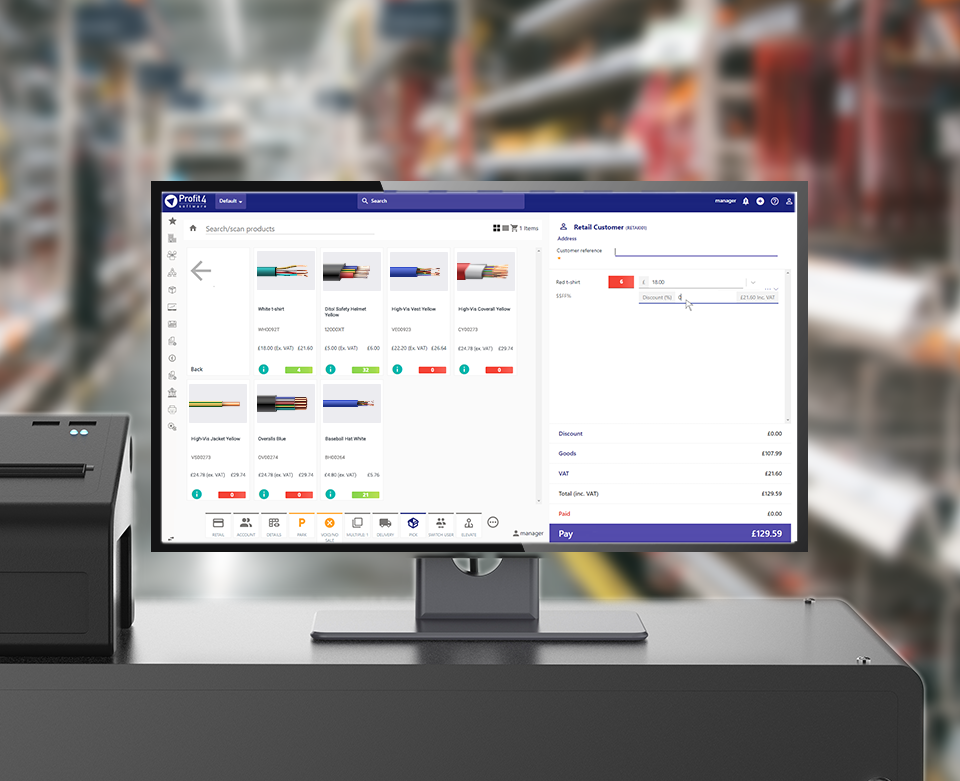


The trade counter is the front line of an electrical wholesale business. For many operators, it's where a significant portion of daily revenue is generated and where the relationship with electricians and contractors is either reinforced or damaged, transaction by transaction.
Electricians are time-critical customers. They're often between jobs, on a tight schedule, and want to be in and out as quickly as possible with the right product at the right price. A trade counter that's slow, unsure, or prone to errors costs you more than just time, it costs you customers who'll quietly start going elsewhere.
This article sets out what best practice looks like at a modern electrical wholesale trade counter, and how ERP software is the operational foundation that makes it possible.
Before addressing software, it's worth being clear about what the customer in front of you requires:
Speed: A contractor who has ten minutes between site visits needs to be served quickly. Searching through multiple screens, waiting for stock checks, or manually calculating prices is unacceptable to a customer on that kind of schedule.
Stock accuracy: Being told a product is in stock and then finding it isn't, or being told it's not in stock and then discovering it is in the warehouse, damages trust immediately. If your trade counter team can't give a confident, accurate answer about stock availability, customers stop asking and start going to someone who can.
Correct pricing the first time: Electricians often have negotiated account terms, specific contract pricing, or entitlement to certain promotional rates. Being charged the wrong price and having to come back or call to get a credit is a friction that erodes the customer relationship over time.
Product knowledge support: Not every transaction is simple. Sometimes a customer needs guidance on whether a product meets a project specification, whether a substitute is available when a first choice is out of stock, or whether an alternative brand meets the same technical standard. Trade counter staff who can answer these questions quickly are providing genuine value.
Account visibility: Customers want to know where they stand, whether they have available credit, whether a previous order is ready for collection or whether an outstanding invoice is being dealt with. Having that information immediately available prevents awkward conversations and builds confidence.
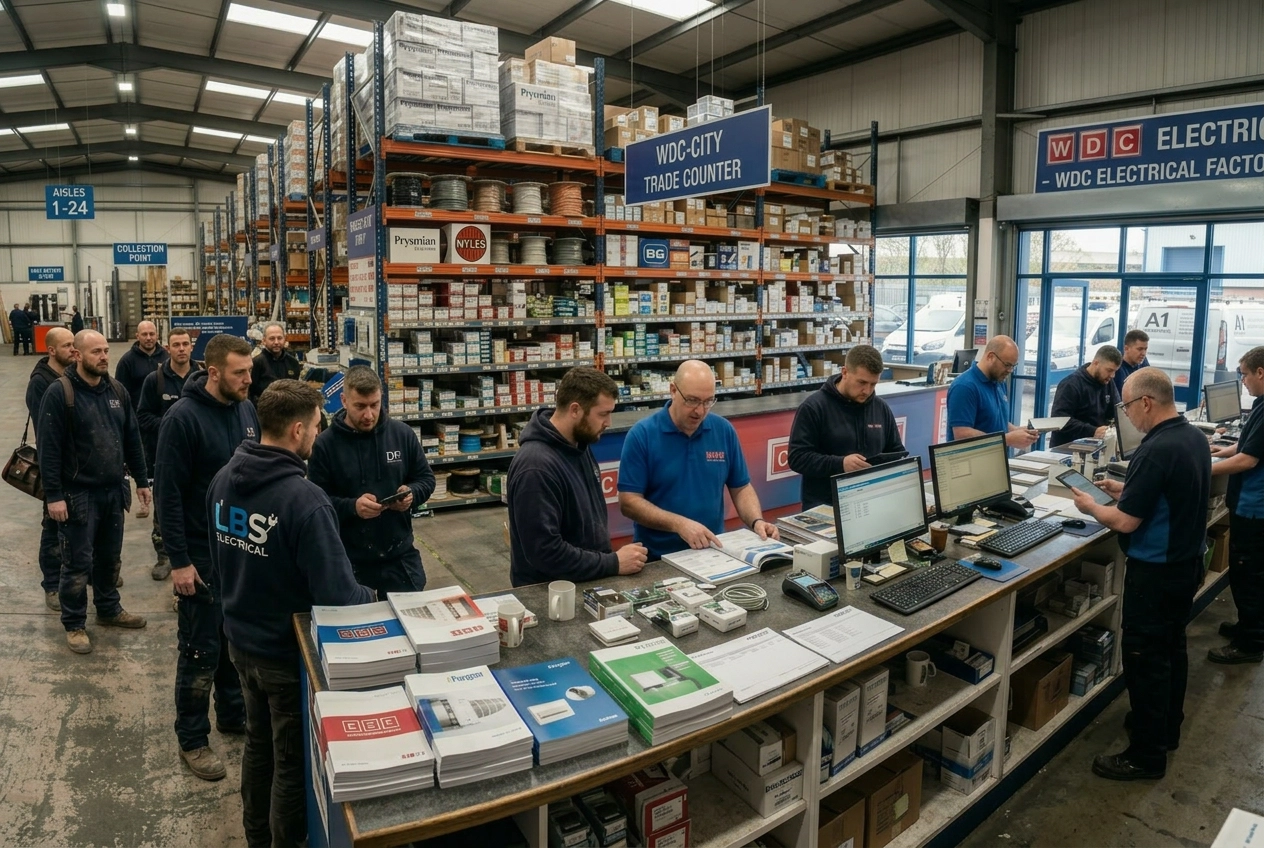 Trade counter service is key to customer loyalty
The most common trade counter failure modes in electrical wholesale are predictable, and most of them have a technological root cause.
Slow product search & missing technical attributes: If staff are navigating through endless category menus or searching by a manufacturer code they have to look up separately, the transaction stalls. Furthermore, generic EPOS systems cannot filter by the complex technical parameters contractors use to describe parts, such as:
Inaccurate stock information: When your trade counter system isn't updated in real time because it's a separate system from your warehouse management, or because stock adjustments happen on a lag, the information your team gives to customers is unreliable. This problem compounds in multi-branch operations where stock may be available at another location.
Manual Pricing errors: A generic system that doesn't automatically apply the correct SPA, contract rate, or account pricing for each customer puts the burden on the trade counter operative. They have to remember, or look up, the right price for each transaction. When they get it wrong, in either direction, there are consequences.
Inability to offer alternatives: When a product is out of stock and the system can't surface a viable substitute with equivalent specifications, the customer walks away empty-handed. An electrical wholesaler who consistently can't meet a customer's needs, even when suitable alternatives exist in the range, loses that customer to a competitor who can.
Disjointed workflows: When the trade counter operates on a different system to the warehouse, the accounts team, and the telephone sales desk, information doesn't flow. A customer who ordered by phone and is picking up at the counter shouldn't have to explain their order twice. A query about an invoice shouldn't require the trade counter team to call the accounts department on the customer's behalf.
An independent merchant or multi-branch operation running on a purpose-built ERP for UK electrical wholesalers operates differently in ways that are instantly visible to the buyer:
Fast, flexible product search with Luckins data integration: Staff can search by manufacturer code, description, or keyword and surface the right item iseconds. With built-in Luckins data integration for electrical wholesalers, your team can find a 2.5mm² twin and earth cable or specialised fire-rated downlight as quickly as a standard socket—without needing to memorise exact catalogue references.
Real-Time stock visibility across all branches: Stock levels shown at the counter reflect actual warehouse inventory in real time. If a product is being picked for a telephone order at that exact moment, the system flags it. If a part is missing locally, the system displays real-time stock visibility at the trade counter for neighbouring branches to arrange an instant inter-branch transfer.
Automatic pricing and margin protection: The software retrieves the correct price for every transaction automatically. Account pricing, contract rates, volume breaks, and copper surcharge fluctuations are calculated instantly without the operative needing to intervene. Margin is protected, and the customer is billed correctly.
Technical equivalent & substitute identification: When a product is out of stock, the system surfaces technical equivalents based on matching properties (like matching lumen output or fire ratings). A trade counter team that can say, "We don't have that exact brand in stock, but this alternative shares the same IP rating and electrical specifications, and we have 40 on the shelf," retains the sale.
Integrated Account & Multi-Channel Order Management: Counter staff can see a customer's credit status, outstanding balance, and history without switching systems. Digital Proof of Delivery (POD) and signature capture integrate with the accounts workflow automatically. Crucially, an order placed via your B2B eCommerce portal or phone sales desk is instantly visible at the desk for collection.
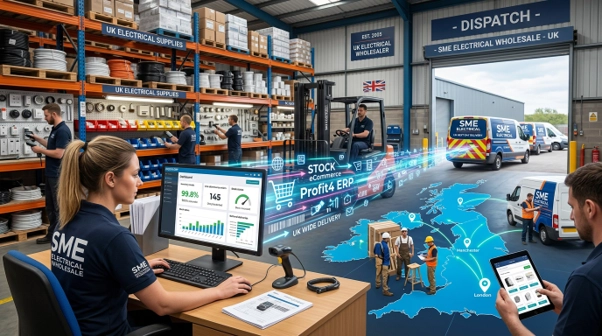 Real time, multi channel stock visibility gives you a competative advantage in 2026
A modern electrical wholesaler doesn't just serve walk-in trade. The same customer might place an order by phone in the morning, collect it at the counter in the afternoon, and submit a follow-up order through the B2B eCommerce portal in the evening.
A system where these channels operate independently creates duplicated effort, inconsistent information, and customer-facing errors. The order placed by phone should be visible at the counter when the customer arrives. The stock allocated for that order should be reflected in the live availability shown to the next counter customer. The invoice should be generated from the same transaction record that created the picking note.
This sounds basic, but it requires an ERP where trade counter, telephone sales, and eCommerce operate on a single shared database — not three separate systems loosely connected by data exports.
The best ERP software in the world is only as useful as the people operating it. Trade counter environments tend to have variable staff experience — some operatives with years of product knowledge, some newer to the sector. A system that works well for the experienced team member should also be navigable for someone newer.
Key usability requirements for a trade counter ERP include:
Training time matters too. A system that requires weeks of training before a staff member can serve a customer independently creates operational risk every time there's a change in the team.
.png) Intuative layout, in person and online training and UK based support makes Profit4 the choice for UK Electrical wholesale
Intuative layout, in person and online training and UK based support makes Profit4 the choice for UK Electrical wholesale
Implementing a new system does not have to mean operational downtime or chaos at your trade counter.
OGL Software provides a specialist, UK-based Software Implementation Team strictly dedicated to making your transition to Profit4 as smooth and efficient as possible.
Because Profit4 is a cutting-edge Cloud ERP system, it eliminates the need for individual desktop installations. Once configured to support your exact wholesale business workflows, your staff can securely access the platform instantly via any internet browser.
The structured deployment process is built around partnership and clarity:
One of the underused benefits of a good ERP is the ability to measure trade counter performance objectively. Beyond the qualitative sense of whether things are running well, data-driven performance management tells you:
This information allows managers to identify where the bottlenecks are, which products need better stock availability during busy periods, and where additional training might make a tangible difference.
Profit4's integrated trade counter and EPOS module unifies every critical workflow into a single, intuitive interface to ensure your trade counter protects profit margins, speeds up customer turnaround times, and builds lasting contractor loyalty.

ERP Software consultant at OGL Software ERP Software for Stockists, Distributors and Merchants | Designed, Developed and Supported in the UK
